For twenty years, getting found online in India meant one thing: winning a search results page. Pick keywords, bid, write a headline, hope for the click.
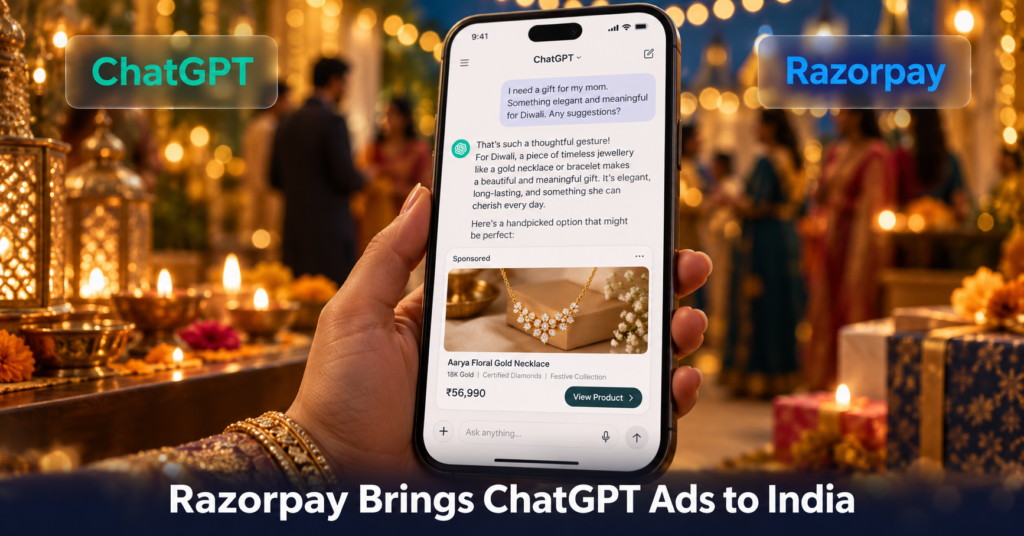
On 5 October 2026, that model got a serious challenger. Razorpay announced that Indian brands can now run ads inside ChatGPT through its marketing platform, Razorpay Engage. Tanishq, Tata Neu, Fastrack and Shaadi.com are among the first names on board.
The headline is about advertising. The real story is about data, and that is where software teams come in. Here is what was announced, how ChatGPT ads actually work in India, what is still unknown, and what your team should do about it.
The News in 60 Seconds
- What: Razorpay Engage now lets Indian brands set up and manage ad campaigns on ChatGPT.
- Who is in: Nine launch brands: Tanishq, Rivaah by Tanishq, Fastrack, Tata Neu, Traya, Shaadi.com, Axis Max Life, Palmonas and NMIMS.
- How it works: Razorpay checks whether a brand’s product catalogue is ready, cleans up the product data feed, builds the campaigns and tracks performance. An AI agent does much of the work, with human oversight.
- Why now: OpenAI opened ChatGPT ads to Indian advertisers in late August 2026, and self-serve access arrived on 4 September.
First, How ChatGPT Ads Work in India
Before Razorpay’s role makes sense, you need the basics of what OpenAI launched. Based on OpenAI’s announcement as reported by Business Standard and others:
- Who sees ads: Logged-in adults (18+) on the Free and Go plans. Go costs ₹399 a month. Users on Plus, Pro, Business, Enterprise and Education plans see no ads.
- What an ad looks like: A sponsored placement that appears below ChatGPT’s answer when it is relevant, clearly labelled as sponsored and kept visually separate from the answer itself.
- How often: OpenAI expects roughly one in five queries to show an ad. It says nearly 80% of queries, the ones with no product or commercial intent, will show none.
- What is off limits: No ads next to sensitive or regulated topics such as health, mental health and politics.
- Privacy: Advertisers do not get access to conversations, chat history, memories or personal information. They get aggregate numbers such as impressions and clicks.
- Entry price: Budgets start at ₹725 a day (about $8) through ChatGPT Ads Manager.
- Agency partners: WPP and Omnicom were named as the first agency partners in India.
The scale is the reason brands are paying attention. OpenAI says ChatGPT had about 330 million unique monthly users in India in May 2026, making it one of its biggest markets.
So Where Does Razorpay Fit?
If brands can already buy ads through ChatGPT Ads Manager, why do they need Razorpay?
Because running a campaign is the easy part. The hard part is the product data underneath it. Razorpay’s pitch, as reported by MediaNama, is that shoppers will increasingly ask AI assistants what to buy instead of typing keywords into a search engine. To show up in those answers, a brand needs structured, clean, complete product information at scale.
Razorpay Engage positions itself as the layer that handles that:
- Assessing whether a brand’s product catalogue is ready
- Organising and cleaning product data feeds
- Creating and operating the campaigns
- Tracking performance and adjusting, using AI agents with human oversight
It is a familiar playbook. Razorpay started by making online payments easy to accept, and it is now moving up the stack to help brands get found and sell inside a new channel.
The Real Story: This Is a Data Problem
Here is the detail that matters most for anyone building software. According to reporting on OpenAI’s ecommerce ad tools, ChatGPT ads for shopping are generated from product feeds: a structured file that ChatGPT ingests and indexes.
- New ecommerce partners start by submitting a sample of about 100 products before the full catalogue.
- A single advertiser can upload up to one million SKUs.
- Brands can reuse the structured product files they already maintain for other ad platforms.
- OpenAI supports cost-per-impression (CPM) and cost-per-click (CPC) buying, and says it is working on cost-per-action models.
This is different from Google or Meta advertising. There, you are bidding on keywords or audiences built from browsing history. In ChatGPT, the ad responds to conversational intent: someone describing what they want, in their own words. A user does not search “gold necklace under 50000”. They say “I need something elegant for my sister’s wedding, around fifty thousand, nothing too heavy.”
For the ad to match that request, the system has to understand your product from its data. A thin, inconsistent catalogue loses to a rich one.
What a “ChatGPT-Ready” Product Catalogue Looks Like
This section is our engineering view, not an official OpenAI checklist. Based on how feed-driven systems generally work, these are the things we would fix first:
- Descriptions written for humans. “Necklace, 22K, 18g, SKU 4471” tells a model very little. Describe the occasion, style, material and who it suits.
- Consistent attributes. If one product says “Rose Gold” and another says “rosegold”, you are making the system guess.
- Accurate price and stock. An ad that sends someone to an out-of-stock product wastes budget and trust. Feeds need to sync with your inventory, not be uploaded once and forgotten.
- Stable, unique product IDs. Reporting and attribution fall apart when IDs change between uploads.
- Good images. Several feeds use product images to build the ad.
- Structured data on your own site. Schema.org Product markup is cheap to add. It helps search engines today and AI assistants that read your pages tomorrow.
- Clean APIs. If your catalogue lives in a legacy system that only exports a spreadsheet on request, this is the moment to fix that.
The brands that win in AI-assisted shopping will not be the ones with the biggest ad budget. They will be the ones whose product data is easiest for a machine to understand.
What We Don’t Know Yet
This is early, and several important questions are unanswered. Reporting on the Razorpay announcement notes that:
- Razorpay’s fees are not public. It is not clear what brands pay for the service on top of their ad spend.
- Live campaign status is unclear. It has not been confirmed that any of the nine launch brands are already running live campaigns.
- There are no performance numbers. Nobody has published results yet: click-through rates, conversions, cost per sale.
- The difference from agency partners is unclear. OpenAI has already named WPP and Omnicom. How Razorpay’s offering compares, and which brands should choose which, has not been explained.
- In-chat purchasing has no date. The long-term vision is buying inside the conversation, but when that arrives in India is unconfirmed.
One more point deserves a careful read. OpenAI says ads do not influence ChatGPT’s answers, which stay based on what the system considers most useful. That is the company’s own commitment. Whether users believe it, and whether it holds up as ad revenue grows, will matter a lot for trust in the product. It is worth watching.
Should Your Brand Rush In?
It makes sense to start testing now if:
- You sell products online and your catalogue is reasonably clean and structured
- Your customers already research purchases conversationally, in categories like jewellery, fashion, beauty, insurance and matrimony
- You can run a small, measurable test. Self-serve budgets start at ₹725 a day, so the downside is small.
It is fine to wait if:
- Your product data is messy and living in several systems. Fix that first, because it helps every channel, not just this one.
- You are a service business with no product catalogue. Expect formats beyond shopping ads to take longer.
- You need proven return-on-ad-spend numbers before committing. They do not exist yet.
A sensible approach is to treat this as an experiment, not a strategy shift. Start small, track what you can, and compare against your existing channels before moving real budget.
What This Means for Developers and Product Teams
If you build software for a living, three things stand out.
1. Product data is now a growth asset. For years, catalogue quality was a back-office concern. When ads, search and shopping assistants all read your data, quality becomes a competitive advantage.
2. Integration is the product. Razorpay is not winning here by building a better ad network. It is winning by sitting between brands’ messy data and a new platform’s strict requirements. There is a lot of value in that kind of plumbing.
3. Feeds need engineering discipline. A feed that syncs price and stock on a schedule needs the same care as any other integration: retries, validation, monitoring and clear error handling. We have written before about idempotency and handling retries safely, and the same thinking applies when your catalogue is being pushed to an external platform that millions of people will use.
Where This Is Heading
ChatGPT ads in India are a few weeks old. It would be a mistake to treat them as a finished channel, or to dismiss them.
The direction is clear: more of the journey from “I need something” to “I bought it” is moving into conversations with AI assistants. Search engines, social platforms and marketplaces all spent years competing to own that moment. A new contender now has hundreds of millions of Indian users, and Razorpay has made a quick bet on helping brands show up there.
Whether the format delivers results remains to be proven. The brands that prepare their product data now will be ready either way.
Frequently Asked Questions
What did Razorpay announce?
Razorpay announced on 5 October 2026 that its marketing platform, Razorpay Engage, lets Indian brands set up and manage ad campaigns on ChatGPT. The first brands include Tanishq, Tata Neu, Fastrack, Traya and Shaadi.com.
Who sees ads in ChatGPT in India?
Logged-in adults on the Free and Go plans. Users on Plus, Pro, Business, Enterprise and Education plans do not see ads. OpenAI says ads are labelled as sponsored and kept separate from ChatGPT’s answers.
How much do ChatGPT ads cost in India?
Self-serve budgets through ChatGPT Ads Manager start at ₹725 a day, according to reports on the India launch. Razorpay’s own fees for Engage have not been made public.
Do advertisers get access to users’ chats?
No. OpenAI says advertisers do not have access to conversations, chat history, memories or personal information. They receive aggregate metrics such as impressions and clicks.
What is a product feed and why does it matter?
A product feed is a structured file containing your product names, descriptions, prices, images and attributes. ChatGPT shopping ads are generated from these feeds, so the quality and completeness of your catalogue directly affects how well your ads can match what shoppers ask for.
Should small businesses use ChatGPT ads now?
It depends on your catalogue and risk appetite. With budgets starting at ₹725 a day, a small test is affordable. But there are no published performance results yet, so treat it as an experiment and compare it against your existing channels.
Sources: MediaNama, NewsBytes, Business Standard, BW Businessworld, MarketingTechNews and BigGo Finance reporting on the Razorpay Engage announcement and the OpenAI ChatGPT Ads launch in India, October 2026. Details such as pricing and availability may change, so check the official OpenAI and Razorpay announcements before making budget decisions. Onclick Innovations is not affiliated with Razorpay or OpenAI.