


Almost every AI model you’ve heard of does the same fundamental thing: it writes. You give it words, it gives you words back. ChatGPT, Claude, Gemini — all of them are, at heart, very sophisticated sentence machines.
On 15 September 2026, a San Francisco lab called TypeSafe AI released a model that refuses to write a single sentence.
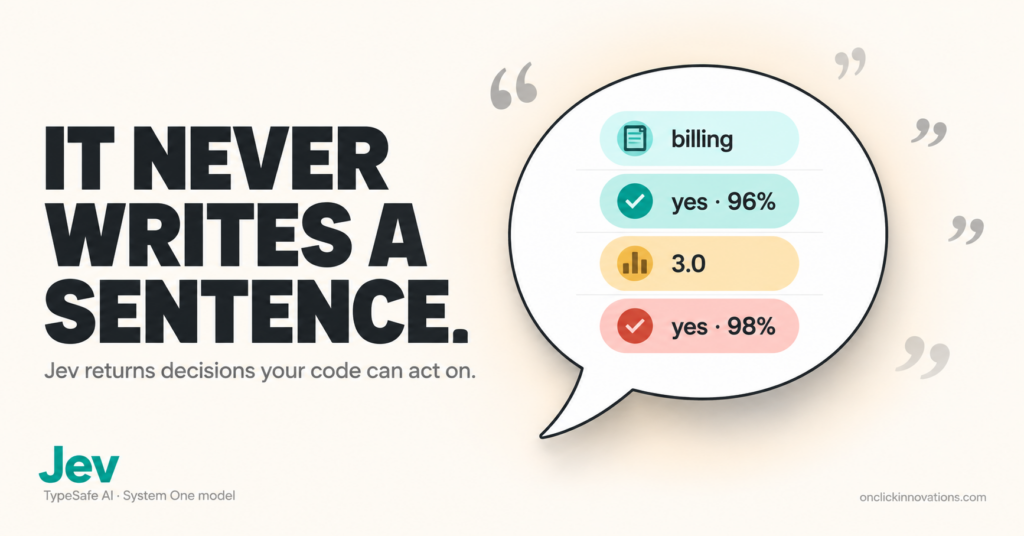
It’s called Jev, and it’s a genuinely different idea. Instead of producing text for a human to read, it produces decisions for software to act on. Ask it a question and it doesn’t answer in prose — it hands back a category, a number, or a yes/no, along with how confident it is.
The launch came with $40 million in seed funding led by DCVC, a founder who helped invent the technique behind ChatGPT, and some eye-catching performance claims. Here’s what it actually is, how it works, what’s genuinely new, and the honest answer to whether it’s worth your attention.
The Problem Jev Is Trying to Solve
Start with something most developers will recognise.
Your software needs to make a small decision. Is this support ticket about billing or technical support? Is this comment abusive? How urgent is this request, on a scale of one to five? Should a human review this before we act on it?
These are tiny, definite questions. But if you want AI to answer them, you currently have to ask a model built to write essays. You send it your question, it writes back a paragraph, and then you write code to dig the actual answer back out of that paragraph.
That extraction step is the fragile part. The model might phrase things differently today than yesterday. It might add a helpful preamble you didn’t ask for. It might return slightly malformed JSON. Developers spend a genuinely silly amount of time writing defensive code to handle a text-generating model that was never designed to give a one-word answer.
It’s also slow and expensive, because generating a paragraph costs the same whether you needed the paragraph or just one word of it.
Now consider what an AI agent does between its interesting moments. Is this request in scope? Which tool should I use next? Is this action reversible? Am I done? Those are reflexes — small judgements made thousands of times a day. Right now, each one costs a full round trip to a model built for essay writing.
That gap is what Jev aims at.
How Jev Actually Works
A Jev request has two parts: state and questions.
The state is your context — a support ticket, a log entry, a user profile, a block of JSON. The questions are what you need decided about it. Crucially, you define the shape of the answer in advance.
There are three question types:
- Choice — pick one from a list you define. “Which team should handle this: billing, technical, sales or account?” You get back one option, plus the probability assigned to every option.
- Score — rate it on a scale you define. “How frustrated is this customer, from calm to ready-to-churn?” You get a number.
- Noul — a yes/no question. “Is the customer threatening to leave?” You get a probability that the answer is yes.
Here’s a real example. Give Jev this state:
“This is the third time I’m writing. Our payouts have failed every day since Monday and my team can’t pay suppliers. I’ve already re-entered the bank details twice. If this isn’t fixed today we’ll have to move to another provider.”
Ask it four questions, and you get back: team = billing (100% confidence), needs response today = yes (96%), frustration = 3.0, angry and ready to churn, threatening to leave = yes (98%).
No paragraph. No parsing. Just values your code can branch on immediately — and all four questions answered in a single call, in parallel.
That parallel bit matters more than it sounds. TypeSafe says Jev can process hundreds of outputs from one prompt. Where an LLM-based approach might need several sequential calls for a complex routing decision, Jev resolves the whole thing in one round trip.
Why It’s Called a “System One” Model
The name comes from psychologist Daniel Kahneman’s book Thinking, Fast and Slow, which splits human thinking into two modes. System 1 is fast, automatic and intuitive — recognising a face, catching a dropped glass. System 2 is slow and deliberate — working through a proof, planning a project.
Today’s LLMs are System 2 machines. They’re built for careful reasoning, and they’re good at it. TypeSafe’s argument is that a huge share of what software actually needs is System 1 work: fast, repetitive, low-drama judgements made constantly in the background. Using a System 2 model for System 1 work is expensive and slow.
The model’s name has its own story. Jev is named after William Stanley Jevons, the economist behind Jevons Paradox — the observation that making a resource cheaper tends to increase total consumption of it rather than reduce it. The bet embedded in the name: once a decision costs almost nothing to make, people will start making it ten times more often.
What Makes It Technically Different
TypeSafe is explicit that Jev is “neither small nor an LLM.” It isn’t a language model with a constrained output bolted on — it’s a different architecture built for evaluating decisions rather than generating text one token at a time.
It’s trained with a method the company calls Reinforcement Learning for Calibrated Decisions (RLCD) — a deliberate echo of RLHF (Reinforcement Learning from Human Feedback), the technique that made ChatGPT work, which TypeSafe’s CEO helped invent.
The word doing the heavy lifting there is calibrated. It means that when Jev says it’s 90% confident, it should be right about 90% of the time. That sounds obvious, but it’s genuinely hard, and most models are bad at it — they’re often confidently wrong.
If calibration holds up, it’s arguably the most useful thing about Jev. It means you can write a rule like: “if confidence is above 95%, let the software act automatically; below that, send it to a human.” That threshold becomes a number you can defend, tune and audit.
The “Zero Hallucination” Claim, Explained Honestly
You’ll see “zero hallucinations” repeated a lot in coverage of Jev. It’s true, but it means something narrower than it sounds, and the distinction genuinely matters.
Because you define the possible answers in advance, Jev physically cannot return something outside that set. If you ask it to choose between billing, technical, sales and account, it cannot invent a fifth category, and it cannot return malformed JSON with a typo in a field name. That entire class of bug disappears.
What it can still do is pick the wrong one. Jev can misclassify a ticket. It just can’t return {"categori": "billng"}.
So: zero schema hallucination, not zero mistakes. That’s a real and valuable guarantee — anyone who has written regex to rescue a value from a half-broken LLM response will appreciate it — but it isn’t a promise of correctness.
Who’s Behind It
TypeSafe AI was founded in 2024 in San Francisco by Diogo Almeida, Erik Gafni and Sasha Sheng, and spent roughly two years in stealth.
Almeida, the CEO, spent about four years at OpenAI working on RLHF, InstructGPT, ChatGPT and GPT-4. He’s a co-author of the InstructGPT paper, which is one of the foundations of modern conversational AI. That’s a substantial track record, and it’s the main reason this launch got taken seriously rather than treated as another AI startup announcement.
His stated reasoning for leaving that world is the clearest summary of the company’s thesis: he spent years making AI better at talking to people, and concluded that if AI is going to change how work gets done, people can’t be the only consumers of intelligence.
The launch came with $40 million in seed funding led by DCVC. Forbes reported the round valued TypeSafe at around $200 million.
One charming detail from the launch coverage: to demonstrate that Jev makes fast decisions for machines rather than conversation for humans, the team had it play Doom.
Pricing and Availability
- Input: roughly $0.042 per million tokens.
- Output: free. There’s very little output to charge for — a category and a probability, not paragraphs.
- Latency: TypeSafe claims under 100 milliseconds. Independent write-ups report real-world figures more commonly in the 70–500ms range.
- Access: limited early access, waitlisted at typesafe.ai.
- Integration: LangChain has published an official integration, exposing Jev through a classifier interface rather than a chat interface.
Two practical limits worth knowing before you plan around it: Jev accepts text only — a string, JSON or an array. No images or PDFs; convert first. And English is its primary language, where it’s most accurate. Other languages work but less reliably, which matters a great deal if you’re building for Indian users across multiple languages.
Now the Hype, Weighed Honestly
This is the part most coverage skips, so let’s be direct about which claims are solid and which aren’t.
What’s independently confirmed
The funding, the founder’s background, and the product’s existence and availability are all corroborated by independent press — The Register, heise online, AIwire and others covered the launch. The founder’s OpenAI history is a matter of public record. Anyone with early access can time the latency themselves.
What’s self-reported and unverified
The headline performance multiples — figures like 193.6× faster and 444.6× cheaper — come from TypeSafe’s own evaluations, using an evaluation format the company itself designed.
To TypeSafe’s credit, they flag the limitations themselves: the test workflows were built by their own team, the reference models chosen bias results in a particular direction, and competing LLMs were run through TypeSafe’s own harness. That’s more transparency than most vendors offer. But a vendor grading itself on a test it invented is not the same as independent verification.
The “0% type error” figure is also worth understanding precisely: it’s derived from how the system is constructed rather than measured from a large sample. That’s a reasonable claim — if the output space is fixed, type errors genuinely can’t occur — but it’s a design property, not an experimental result.
And the most important claim of all, calibration, is the one no outside party has tested yet. The entire practical value of “act automatically above 95% confidence” depends on that 95% meaning what it says. Until someone independent measures it on real workloads, it remains a promise.
So Is It Actually Worth It?
Here’s an honest assessment.
The underlying idea is sound, and probably right. Using an essay-generating model to answer yes/no questions thousands of times a day genuinely is wasteful, and the fragile parse-the-paragraph step genuinely is a common source of production bugs. A model purpose-built for structured decisions addresses a real problem that real teams have.
It’s not a replacement for your LLM. TypeSafe is clear about this, and it’s worth repeating because some coverage blurs it. Jev doesn’t write, summarise, explain or converse. The intended pattern is both together: an LLM for open-ended work, Jev for the fast structured decisions around it.
It’s early. Limited access, English-first, text-only, and headline numbers that haven’t been independently reproduced. TypeSafe itself describes Jev as being in its early days.
Who should pay attention now: teams running high-volume classification, routing or moderation where latency and cost per call actually determine whether a feature is viable. Also teams building agents, where the number of small decisions per task is the thing quietly driving the bill.
Who can comfortably wait: anyone whose AI feature makes a modest number of decisions per day. At low volume, the saving is theoretical and your existing LLM call is fine. Also anyone building primarily for non-English users, at least for now.
The most sensible move isn’t to adopt or dismiss it. It’s to look at your own system and ask how many times a day it asks a text-generating model a question whose answer could have been one word. If that number is large, this category is worth watching closely — whether the winner ends up being Jev or something that follows it.
What This Means for Where AI Is Heading
Step back from this one model and there’s a larger pattern worth noticing.
For three years, “better AI” has mostly meant one thing: a bigger, smarter, more general model. Jev is a bet in a different direction — that the next useful step isn’t a smarter model but a more dependable one that software can call like an ordinary function.
That points toward production systems that mix model types by task rather than standardising on one model per company. A small, fast, calibrated model for the thousand routine judgements; a large reasoning model for the handful of genuinely hard ones.
It’s the same conclusion that keeps surfacing in agent engineering more generally: the intelligence matters, but so does the plumbing around it — what gets called, when, with what fallback, and at what cost. Notably, LangChain’s own write-up of Jev framed it as a component in building an agent harness, not as a model to swap in wholesale.
Whether Jev specifically becomes infrastructure or a footnote, that architectural direction looks durable.
Frequently Asked Questions
What is Jev AI?
Jev is an AI model from TypeSafe AI, released in limited early access on 15 September 2026. Unlike an LLM, it doesn’t generate text. It takes a block of context and typed questions, and returns categories, scores and yes/no answers with calibrated confidence — designed to be consumed by software rather than read by a person.
What is a “System One” model?
It’s TypeSafe’s term for a class of model built for fast, structured decisions rather than text generation. The name references Daniel Kahneman’s System 1 thinking — fast and intuitive — as opposed to the slow, deliberate reasoning that LLMs are built for.
Is Jev a replacement for ChatGPT or Claude?
No, and TypeSafe doesn’t claim it is. Jev can’t write, summarise or converse. It’s intended to work alongside an LLM: the LLM handles open-ended generation and reasoning, Jev handles the fast structured decisions around it.
Does Jev really have zero hallucinations?
It has zero schema hallucinations. Because you define the possible answers in advance, it can’t invent a category or return malformed output. It can still choose the wrong answer — it just can’t produce a structurally invalid one.
How much does Jev cost?
Input is priced at roughly $0.042 per million tokens, and output tokens are free, since the output is a value rather than text. It’s currently in limited early access via a waitlist.
Who founded TypeSafe AI?
Diogo Almeida (CEO), Erik Gafni and Sasha Sheng, in 2024. Almeida spent around four years at OpenAI working on RLHF, InstructGPT, ChatGPT and GPT-4, and is a co-author of the InstructGPT paper. The company emerged from stealth in September 2026 with $40 million in seed funding led by DCVC.
Are Jev’s performance claims verified?
Partly. The funding, founder background and product availability are confirmed by independent press. The headline speed and cost multiples come from TypeSafe’s own evaluations using a format the company designed, and the calibration claim — arguably the most important one — has not yet been independently tested.
Sources: TypeSafe AI’s launch announcement (15 September 2026) as carried by Business Wire, Yahoo Finance, Morningstar and AIwire; The Register and heise online launch coverage; Wikipedia’s entry on Jev; TrueFoundry’s analysis of TypeSafe’s benchmark methodology; LangChain’s published Jev integration. Note that the official product site is typesafe.ai — a number of other Jev-branded sites are independently operated and not affiliated with TypeSafe AI.