Every founder building with AI eventually asks the same questions: Do we need our own model? Which cloud? GPUs or something else? Should we copy ChatGPT’s stack?
The honest answer is the same one that shows up when you study Netflix or WhatsApp: it depends. And there is no better proof than looking at what the world’s most famous AI products are actually built with.
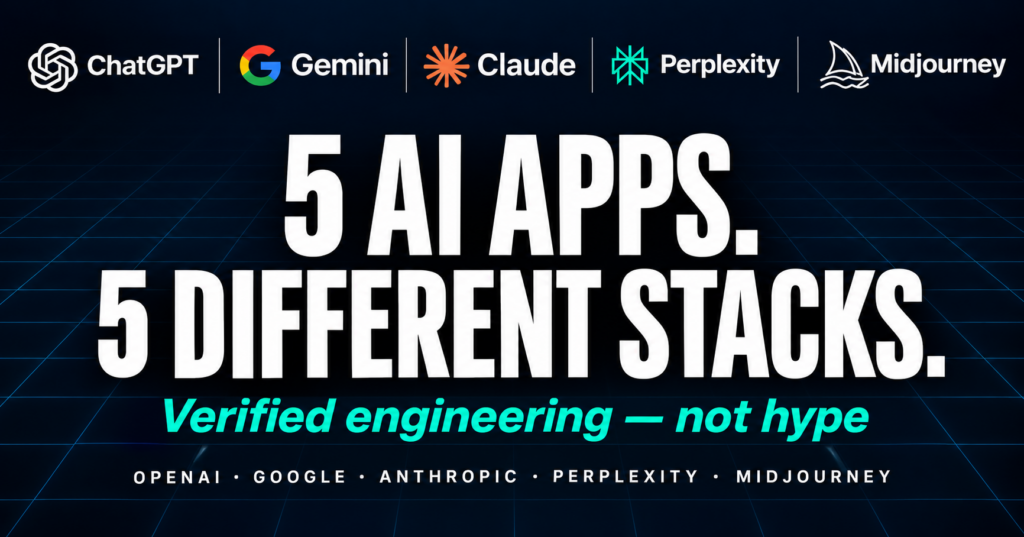
ChatGPT, Gemini, Claude, Perplexity and Midjourney all look like “AI apps” from the outside. Under the hood, they solve different problems — conversation at planetary scale, multimodal models on custom chips, multi-cloud inference, real-time web search, and creative image generation through a community platform. Their stacks reflect those problems, not a universal AI template.
Here is what each is built with, based on company blogs, cloud case studies, research papers and official engineering disclosures — and the lesson behind each choice.
ChatGPT (OpenAI): Python, Azure, Kubernetes — and a lot of PostgreSQL
ChatGPT is the product that made generative AI mainstream. The public story is “large language models.” The engineering story is inference systems, data stores and streaming pipelines under extreme growth.
OpenAI’s own job postings and engineering context describe a Python-heavy stack. Model inference runs through a service wrapping PyTorch transformers. Core technologies repeatedly cited include Python, PyTorch, CUDA, Triton, Redis, high-speed GPU networking (InfiniBand, NCCL, NVLink), plus FastAPI, Terraform, Buildkite, Kafka and databases such as Postgres and Cosmos DB. At the centre of the infrastructure is a large deployment of GPU nodes across dozens of Kubernetes clusters in multiple regions — primarily on Microsoft Azure.
The most surprising public detail is not the GPUs. It is the database. In January 2026, OpenAI published Scaling PostgreSQL to power 800 million ChatGPT users. Over the prior year, PostgreSQL load grew more than 10x. ChatGPT and the API still relied on a single primary Azure PostgreSQL flexible server for writes, with nearly 50 globally distributed read replicas, serving millions of queries per second for hundreds of millions of users. OpenAI moved newer, shardable, write-heavy workloads to Azure Cosmos DB, while keeping hard-to-shard systems on Postgres with aggressive optimisation, pooling and caching.
For event streaming and data pipelines, OpenAI engineering has described a platform centred on Apache Kafka and PyFlink on Kubernetes — chosen specifically so Python remains the default language across research and production streaming work.
The lesson: an AI product is not only a model. At ChatGPT scale, the hard problems include inference efficiency, read-heavy product databases, and Python-friendly infrastructure that researchers and product engineers can actually operate. “Boring” Postgres still sits under one of the most advanced consumer AI apps in the world.
Gemini (Google DeepMind): TPUs, JAX, XLA and Pathways
Gemini is Google’s flagship multimodal model family. Unlike most startups buying NVIDIA capacity from a cloud marketplace, Gemini was designed around Google’s own accelerators and compilers.
Google’s Gemini technical report describes Transformer-based models trained and optimised for inference on Tensor Processing Units (TPUs). Training used TPUv4 and TPUv5e fleets depending on model size. Gemini Ultra training used a large TPUv4 fleet across multiple datacentres. TPUv4 “SuperPods” contain thousands of chips connected through high-speed interconnects; Google combines SuperPods across datacentres using its internal network, with model parallelism inside a SuperPod and data parallelism across SuperPods.
On the software side, Google’s production AI stack centres on JAX, compiled through XLA, with distributed partitioning via systems such as GSPMD and the Pathways runtime. Google’s developer materials describe the broader “JAX AI Stack” — JAX, Flax, Optax, Orbax — co-designed with TPU hardware so researchers can write Python-like code that compiles into efficient accelerator programs. Product surfaces such as the Gemini app and AI Mode in Search then sit on top of Google’s wider serving and cloud infrastructure.
The lesson: when you own the full stack — chips, compilers, datacentre network and model code — you can co-design hardware and software instead of renting a generic GPU box. Most companies cannot (and should not) copy this. The transferable idea is narrower: treat model performance as a systems problem, not only a research problem.
Claude (Anthropic): multi-cloud compute as strategy
Claude’s public brand is safety and useful assistants. Anthropic’s infrastructure story is diversification.
Anthropic has publicly described a deliberate multi-platform compute strategy across Amazon Trainium, Google TPUs and NVIDIA GPUs (with later disclosures also referencing broader accelerator partnerships). AWS is repeatedly positioned as a primary training and cloud partner, including large Trainium deployments and Claude availability through Amazon Bedrock. Separately, Anthropic expanded Google Cloud TPU capacity and has discussed serving Claude inference on Google Kubernetes Engine (GKE) with accelerator node pools. Claude is also available across major clouds, including Bedrock, Vertex AI and Azure.
Google Cloud has also published how Anthropic moves training and inference telemetry across AWS and Google Cloud using services such as Pub/Sub, with private connectivity for sensitive research workloads.
The lesson: at frontier-model scale, compute supply risk is existential. Anthropic’s stack is not “pick one cloud and one chip.” It is an orchestration and efficiency problem across multiple accelerator families — so product availability does not depend on a single supplier’s capacity cycle.
Perplexity: search infrastructure first, models second
Perplexity looks like a chatbot. Architecturally, it is closer to a modern search engine with an LLM on top.
In its own engineering write-up on the Search API, Perplexity describes production search infrastructure handling about 200 million daily queries, with an exabyte-scale index, hybrid lexical + semantic retrieval, multi-stage ranking, and dynamic content understanding. Crawler and indexing fleets are described as tens of thousands of CPUs and hundreds of terabytes of RAM, with warm/cold storage decisions driven by models and heuristics.
For the retrieval engine itself, Vespa.ai has published that Perplexity builds AI search at scale on Vespa — indexing billions of pages and files as text, vectors and metadata, then retrieving and scoring candidates fast enough to feed an LLM with citations.
On the model and cloud side, AWS case studies describe Perplexity running on AWS, using foundational cloud services, Amazon Bedrock for Claude models, SageMaker and GPU instances such as EC2 P4de for training/fine-tuning, alongside Perplexity’s own models (Sonar family). Anthropic’s customer materials similarly note Perplexity routing across Claude model tiers for cost/latency tradeoffs. Perplexity’s docs also describe multi-provider orchestration across OpenAI, Anthropic, Google, xAI and its own models.
The lesson: if your product promise is “answers with sources,” the differentiating stack is retrieval, ranking and indexing — not only which frontier model you call. Models are swappable. Search quality is the moat.
Midjourney: Discord as the product surface, Google Cloud as the factory
Midjourney’s growth story is one of the strangest and most instructive in AI. For a long time, the product experience lived primarily inside Discord: users typed /imagine, watched images appear through message updates, and learned prompt craft in public channels.
Discord’s own case study describes how Midjourney used Discord APIs for real-time progress edits and public sharing — turning generation wait time into a social reveal. Discord engineering later documented the “Maxjourney” work required to support Midjourney-scale communities, including mega-servers with enormous concurrent online populations.
Behind that chat UI, Midjourney’s compute story is more conventional AI infrastructure. A 2023 Google Cloud announcement quoted founder David Holz saying Midjourney trained algorithms on TPU v4 with JAX and ran inference on huge clusters of GPUs on Google Cloud. Midjourney’s own docs make the product economics explicit: subscriptions buy GPU time (Fast / Relax / Turbo), because image and video generation are accelerator-bound workloads.
The lesson: you do not always need to invent the distribution layer. Midjourney shipped creativity through an existing social platform and concentrated engineering on model quality, GPU scheduling and community mechanics. Distribution can be borrowed. Compute cannot.
What these five AI stacks teach founders and CTOs
Looking across ChatGPT, Gemini, Claude, Perplexity and Midjourney, five patterns matter more than any single framework choice.
1. AI apps are systems, not demos. The model is necessary but not sufficient. Databases, queues, caches, retrieval layers, accelerator scheduling and observability decide whether the product feels instant or broken.
2. There is no universal AI stack. OpenAI leans on Azure + GPUs + Python services. Google co-designs around TPUs + JAX. Anthropic spreads risk across Trainium, TPUs and GPUs. Perplexity invests in search. Midjourney paired Discord distribution with Google Cloud accelerators.
3. “Boring” data systems still win. OpenAI’s public Postgres story is the clearest example. Frontier models did not remove the need for careful relational engineering; they amplified it.
4. Product shape drives architecture. Chat products optimise for session state and inference latency. Answer engines optimise for retrieval. Image tools optimise for GPU queues and UX during wait time. Copy the product shape, not a random competitor’s repo.
5. Start with leverage, then specialise. Most teams should begin with a strong API model, a clean application backend, solid observability and a retrieval strategy if facts matter. Build custom training clusters only when the business truly requires it.
How Onclick Innovations thinks about AI product architecture
At Onclick Innovations, we do not pretend every client needs a private foundation model or a thousand-GPU cluster. Most successful AI products we see start with a clear workflow, reliable application engineering, and disciplined use of model APIs — then add retrieval, tools, evaluation and scaling controls as real usage demands it.
The companies in this article prove the same point at extreme scale: technology choices should follow the actual problem. ChatGPT’s problem is serving conversation and platform load globally. Gemini’s problem includes co-designed training at Google scale. Claude’s problem includes compute resilience. Perplexity’s problem is trustworthy search. Midjourney’s problem is creative generation plus community distribution.
If you are planning an AI product — chatbot, search assistant, internal copilot, or creative tool — we can help you choose an architecture that fits your stage, not someone else’s press release.
FAQ
What tech stack does ChatGPT use?
OpenAI publicly describes a Python-centred production environment with PyTorch inference, Kubernetes GPU clusters on Azure, Kafka/streaming systems, Redis and related services. A 2026 OpenAI engineering post also explains how Azure PostgreSQL (single primary + many read replicas) powers major ChatGPT/API workloads for hundreds of millions of users, with shardable writes moving toward Cosmos DB.
What powers Google Gemini under the hood?
Google’s Gemini report and infrastructure materials describe training and serving around TPUs, with software based on JAX, XLA and Pathways-style distributed runtimes — a vertically integrated Google stack rather than a generic rented GPU setup.
Where does Claude run?
Anthropic has disclosed a multi-cloud accelerator strategy spanning Amazon Trainium, Google TPUs and NVIDIA GPUs, with AWS as a major training/cloud partner and Claude also served through platforms such as Bedrock and Google Cloud infrastructure including GKE for inference workloads.
Is Perplexity just a wrapper around GPT or Claude?
No. Perplexity’s own engineering materials emphasise large-scale search indexing, hybrid retrieval and multi-stage ranking. Vespa and AWS case studies describe search/retrieval infrastructure and multi-model serving, including Claude via Bedrock and Perplexity’s own models.
What is Midjourney built on?
Product interaction historically centred on Discord bots and community servers, while Google Cloud materials state Midjourney trained with JAX on TPUs and ran inference on large GPU clusters. Midjourney’s docs frame subscriptions around GPU time.
Should a startup copy these AI stacks?
No. These stacks were shaped by extreme scale, proprietary chips, or specialised product bets. Startups should begin with proven application frameworks, managed model APIs, strong evaluation/observability, and retrieval where needed — then evolve under real load.