

Every founder eventually asks some version of the same question: what programming language should we use? What database? Should we build microservices or a monolith? The honest answer is almost always “it depends” — and there is no better illustration of this than looking at what the world’s most successful apps are actually built with.
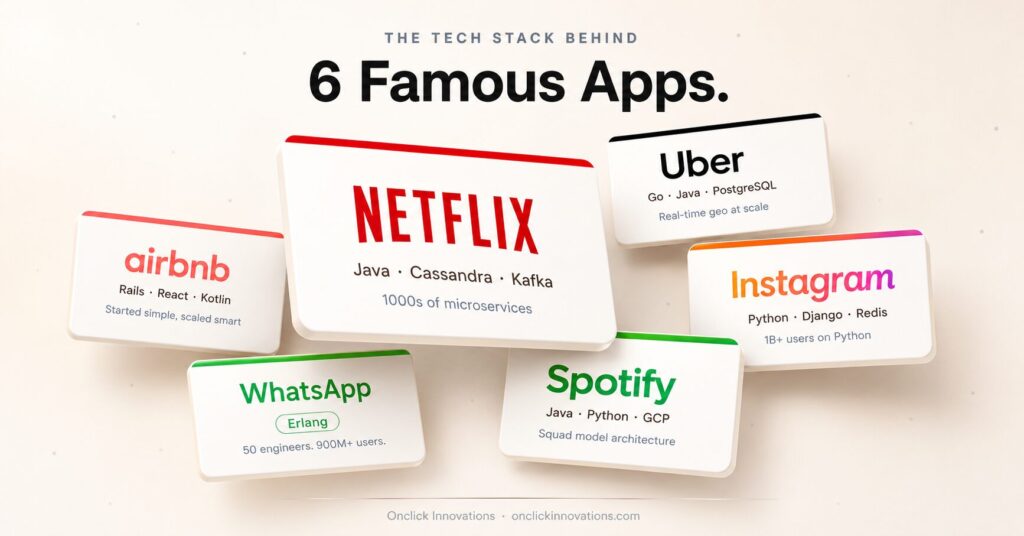
The technology choices behind Netflix, Uber, WhatsApp, Instagram, Spotify and Airbnb reveal something the framework debates on social media rarely admit: there is no universally “best” stack. There is only the right stack for a specific problem, at a specific scale, with a specific team. Here is what each of these companies actually runs on — and the lesson behind each choice.
Netflix: Java, Cassandra and a Custom-Built CDN
Netflix serves over 300 million subscribers across 190 countries and is responsible for a significant share of global downstream internet traffic. Its technology choices reflect the scale of that challenge.
The frontend runs on React, with GraphQL (via Netflix’s open-source DGS framework) handling data fetching for most modern client surfaces, after years of relying on a custom system called Falcor. The backend is built predominantly in Java with Spring Boot, powering thousands of independently deployable microservices. Python and Go handle specific domains including machine learning and observability tooling.
For data storage, Netflix relies on Apache Cassandra as its primary scale-out NoSQL store, EVCache (a memcached-based system) for high-speed caching, and MySQL for transactional data like billing. Real-time data movement runs through Kafka and Netflix’s own streaming platforms, Mantis and Keystone.
Perhaps the most striking architectural decision is Open Connect — Netflix’s proprietary content delivery network. Rather than relying entirely on third-party CDNs, Netflix places its own caching servers directly inside internet service provider networks around the world, pushing content as close to viewers as possible during off-peak hours.
The lesson: when you operate at a scale where standard infrastructure no longer fits your problem, building proprietary infrastructure becomes the rational choice — not over-engineering.
Uber: Polyglot Microservices Built for Real-Time Geography
Uber’s engineering challenge is fundamentally about real-time coordination across location, time and millions of simultaneous transactions. The company’s technology stack reflects a deliberate move away from a single dominant language toward a polyglot microservices architecture.
Uber’s backend spans Go, Java and Node.js, chosen for different services based on performance requirements and team expertise. The company famously built its own database system, internally known as Schemaless, on top of MySQL to handle the specific consistency and scale requirements of ride data. PostgreSQL and MySQL both appear throughout the broader system for different workloads. Kafka handles the real-time event streaming that powers live trip tracking, surge pricing calculations and driver-rider matching.
Uber migrated from an early monolithic architecture to microservices specifically because a single application could not be scaled, deployed and maintained fast enough to support the company’s growth. This migration was not undertaken on day one — it happened in response to genuine scaling pressure.
The lesson: architecture should follow the shape of your actual problem. Uber’s real-time, geographically distributed coordination problem demanded an architecture that could evolve service by service, rather than a single codebase trying to do everything.
WhatsApp: Erlang and the Power of the “Boring” Choice
WhatsApp’s technology story is one of the most instructive in the industry. At the time of its acquisition by Facebook in 2014, WhatsApp was famously serving hundreds of millions of users with an engineering team that numbered only in the dozens.
The reason this was possible comes down largely to one technology choice: Erlang. Erlang is a programming language originally built by Ericsson for telecommunications systems — designed from the ground up to handle massive numbers of concurrent, lightweight connections with extremely high reliability. It is not a trendy language. It was never going to top a “hottest frameworks of the year” list. But it was exactly suited to WhatsApp’s core problem: keeping millions of persistent connections open simultaneously, reliably, with minimal overhead.
The lesson: the most-discussed technology is rarely the most appropriate one. WhatsApp chose a niche, decades-old language because it was the correct tool for the specific problem — and that choice let a tiny team support an enormous user base.
Instagram: Scaling to a Billion Users on Python
Instagram is frequently cited as proof that the programming language you choose matters far less than how you architect around it. The platform’s backend is built primarily in Python using the Django framework — a combination often dismissed as too slow for applications at serious scale.
Instagram has scaled past a billion users on this foundation. The data layer relies on PostgreSQL for core relational data and Cassandra for specific high-volume, high-availability workloads. Caching is handled through Memcached and Redis, which absorb the read load that would otherwise hit the database directly for every request.
What made this scale possible was not a language switch but disciplined engineering around the language: aggressive caching strategies, careful database sharding, asynchronous processing for non-critical paths, and a willingness to optimise the specific bottlenecks that actually appeared under real load rather than guessing in advance.
The lesson: a programming language’s raw performance characteristics matter far less at scale than the architecture built around it. Bad architecture will make a fast language slow. Good architecture can make a famously “slow” language scale to a billion users.
Spotify: Microservices and the Squad Model
Spotify’s technology stack centres on Java and Python across a large number of independently owned microservices, with Google Cloud Platform and BigQuery handling much of its data infrastructure, and Kafka powering real-time event streaming for everything from play counts to recommendation signals.
What makes Spotify particularly interesting is not just the technology but the organisational model built around it. Spotify popularised the “squad” model — small, autonomous, cross-functional teams that each own a specific service or feature area end to end, with the freedom to choose their own tools and deployment cadence within broad guardrails.
This organisational structure and the underlying microservices architecture reinforce each other. Independent services map naturally onto independent teams, allowing Spotify to ship changes across a vast product surface without every team needing to coordinate on every release.
The lesson: technical architecture and organisational structure are deeply connected. The way you split your codebase into services often ends up mirroring — or should mirror — the way you split your teams. This is sometimes called Conway’s Law, and Spotify is one of its most-cited modern examples.
Airbnb: Starting on Rails, Evolving Under Scale
Airbnb’s technology story is a useful counterpoint to the others on this list because it illustrates evolution rather than a single static stack. The platform was originally built on Ruby on Rails — a framework chosen specifically for the speed at which it allowed a small founding team to build, iterate and ship a working product.
As Airbnb scaled into a global marketplace processing complex search, pricing and trust-and-safety logic, the company began migrating performance-critical and team-isolated portions of its system toward service-oriented architectures using languages including Java and Kotlin, while React became the standard for frontend development. MySQL and Redis remain core to the data layer.
Airbnb did not rewrite everything overnight, and it did not start with a microservices architecture from day one. The migration happened gradually, driven by specific scaling pain points rather than a wholesale rejection of the original technology choice.
The lesson: starting with a framework optimised for development speed is often the correct early-stage decision, even if it is not the architecture you will run at massive scale. Re-architecting in response to real growth is normal and expected — it is not a sign that the original choice was wrong.
What These Six Stacks Teach Every Founder and CTO
Looking across all six companies, four patterns emerge that matter far more than any individual technology choice.
There is no universally best stack. Java works for Netflix and Spotify. Python works for Instagram. Erlang works for WhatsApp. Ruby on Rails worked for early Airbnb. Each choice was correct for the problem, team and stage it was made for — not because of any inherent superiority of the language itself.
Boring, proven technology beats trendy technology at scale. None of these companies built their core infrastructure on whatever was generating the most hype on social media at the time. Cassandra, MySQL, Kafka and PostgreSQL are not exciting choices. They are reliable ones, with deep operational knowledge available across the industry.
Architecture matters more than the language itself. Instagram on Python and WhatsApp on Erlang both scaled to enormous user bases despite using technologies that are, by raw benchmark numbers, far from the fastest options available. The architecture built around the language — caching strategy, database design, service boundaries — determined the outcome far more than the language choice alone.
Start simple and re-architect when growth demands it. Airbnb did not start with a complex microservices architecture. WhatsApp did not start by trying to anticipate Facebook-scale traffic. Every one of these companies built something that worked for their actual stage, then evolved the architecture as real scaling pressure emerged — not in anticipation of hypothetical future scale.
How Onclick Innovations Approaches Technology Decisions
At Onclick Innovations, we do not have a default stack we push onto every client regardless of fit. We have built production applications in React, Vue and Angular for the frontend, and Node.js, Python, PHP and Java for the backend — choosing based on the specific project, team, timeline and long-term maintenance considerations involved.
The pattern across the six companies in this article holds true for every project we work on, regardless of size: the right technology choice is the one that fits the actual problem you are solving today, with room to evolve as your product and user base grow. Not the most fashionable choice. Not the one with the most active hype on social media this month. The right one for your specific situation.
If you are making technology decisions for a new product, or reconsidering the architecture behind an existing one, we are happy to talk through the tradeoffs honestly.
📩 Get in touch → www.onclickinnovations.com
📍 Based in Mohali, India · Serving clients globally across 10+ countries
Frequently Asked Questions
What programming language does Netflix use?
Netflix uses Java with Spring Boot as the primary language for its backend microservices, React for its frontend, and Python and Go for specific domains like machine learning and observability. Its data layer relies on Apache Cassandra, EVCache and MySQL, with Kafka handling real-time event streaming.
Why does WhatsApp use Erlang?
WhatsApp chose Erlang because it was specifically designed for telecommunications systems that need to handle massive numbers of concurrent, lightweight connections with high reliability and minimal overhead. This made it exceptionally well suited to WhatsApp’s core technical challenge of maintaining millions of simultaneous persistent connections, allowing a small engineering team to support an enormous global user base.
How did Instagram scale to a billion users on Python?
Instagram scaled on Python and Django through disciplined architecture rather than raw language performance: aggressive caching with Memcached and Redis, careful database sharding across PostgreSQL and Cassandra, and asynchronous processing for non-critical operations. This demonstrates that architectural decisions around a language matter more than the language’s raw benchmark speed.
Should a startup choose the same tech stack as a company like Netflix or Uber?
No. The technology choices made by Netflix, Uber and similar companies were shaped by their specific scale, team size and problem domain at the time those decisions were made — often after years of evolution from much simpler starting points. A startup should choose technology that fits its current stage, team expertise and actual requirements, with an architecture that can evolve as real growth demands it, rather than copying the infrastructure of a company operating at a vastly different scale.
Can Onclick Innovations help us choose the right technology stack for our product?
Yes. We help clients evaluate technology decisions based on their specific project requirements, team composition, timeline and growth plans rather than defaulting to a single preferred stack. Contact us at onclickinnovations.com to discuss your project.