


When India plays a World Cup knockout match, something happens on the internet that has no real equivalent anywhere else on Earth. Tens of millions of people press play on the same live video, at the same second, on the same platform. And it just works.
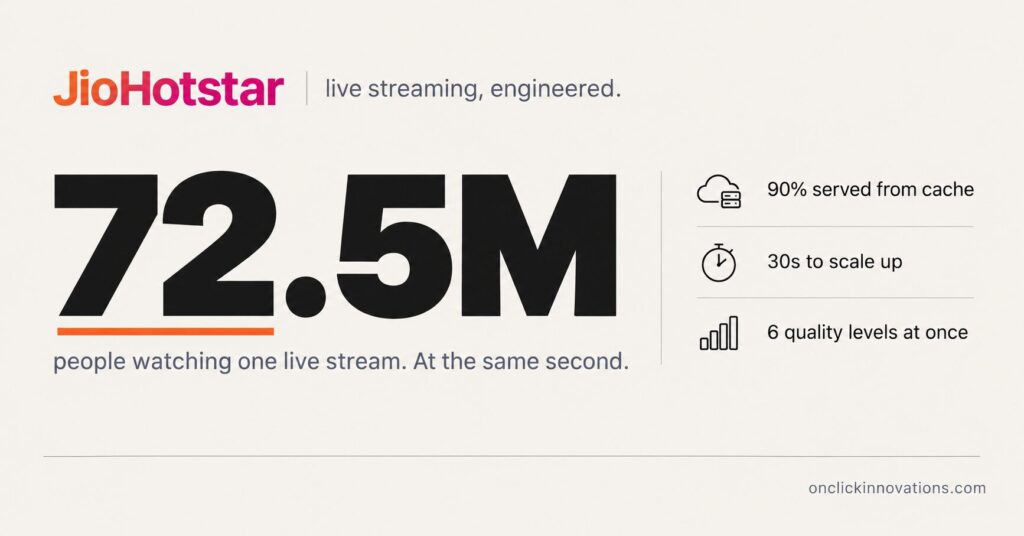
In 2026, JioHotstar reported a peak of roughly 72.5 million concurrent viewers during the ICC Men’s T20 World Cup final — a figure Reliance cited as a global record for a single live stream. To put that in perspective, the Super Bowl, the biggest live event in American media, peaks at somewhere around 10 to 12 million concurrent streams. JioHotstar routinely handles six to seven times that number, on a network where the same match is being watched on a 5G phone in Mumbai and a patchy 2G connection in rural Bihar at the same time.
How does a single platform pull this off without the whole thing collapsing? The answer is a genuinely fascinating piece of engineering. Here’s a breakdown of what actually makes it work.
First, A Note on the Numbers
Cricket streaming numbers in India get thrown around loosely, so it’s worth being precise. There are two very different metrics that often get confused:
- Concurrent viewers — how many people are watching at the exact same moment. This is the hard engineering number. JioHotstar’s verified peak here is around 72.5 million.
- Cumulative reach — how many unique people watched at any point across a match or a tournament. This is where you see figures in the hundreds of millions or billions (IPL 2025 reportedly drew over a billion viewers across TV and digital combined).
Both are real, but they measure completely different things. The concurrency number is the one that keeps engineers awake at night, because that’s the load the system has to survive in a single instant. Everything below is about how that instant is handled.
The Core Problem: Cricket Traffic Isn’t Smooth, It’s Explosive
Most streaming platforms deal with fairly predictable demand. People start a Netflix show whenever they feel like it, spread across the evening. Cricket does the opposite.
Hotstar’s own engineers have described traffic that can spike 20x within ten minutes of a match starting. Worse, the spikes happen mid-match too. When a star batter walks out to the crease, or a wicket falls in a tense final over, millions of people who stepped away suddenly rush back at once. Tens of millions of users can join within a single over.
This creates a specific, brutal engineering challenge called the thundering herd: a huge number of clients all requesting the same thing at the same instant, potentially overwhelming any server that isn’t ready for them. The entire architecture is designed around surviving these sudden surges, not just handling a high steady load.
Building Block 1: Adaptive Bitrate Streaming
The single most important idea in mass live streaming is that not everyone gets the same video. Through a technique called adaptive bitrate (ABR) streaming, the platform encodes every live stream into multiple quality versions simultaneously — 4K, 1080p, 720p, 480p, 360p, and stripped-down low-bandwidth versions for 2G connections.
The app on your phone constantly measures your available bandwidth and picks the right version, switching seamlessly if your connection changes — without ever interrupting playback. A viewer on stadium Wi-Fi might get 360p while a viewer on home fibre gets 4K, both watching the same match from the same infrastructure, just receiving different renditions.
This isn’t a nice-to-have. In a country with wildly varying network quality, ABR is the core mechanism that lets one platform serve everyone at once instead of buffering for half of them.
Building Block 2: A Multi-CDN Strategy
Here’s a physics problem: delivering video to 70 million people simultaneously from a central set of servers is simply impossible. The bandwidth doesn’t exist. The solution is the Content Delivery Network (CDN) — a globally distributed network of edge servers that cache content close to viewers.
JioHotstar doesn’t rely on just one. It runs a multi-CDN strategy, distributing traffic across several providers (Akamai has long been a core partner, alongside others) and using an in-house load optimizer that dynamically routes each viewer through the least-congested CDN in real time, based on live measurements of latency and packet loss. If one provider starts struggling, traffic shifts to another automatically.
The result of all this caching is dramatic: during live cricket, over 90% of content requests are served from CDN cache rather than origin servers. That single fact is the biggest scaling lever in the whole system. At a 90% cache hit rate, the origin infrastructure only has to handle roughly a tenth of the apparent load — still enormous, but survivable.
Cache hit rate is the primary scaling lever. At 90%, the platform serves ten times the load its origin servers actually see.
Building Block 3: The Custom Autoscaler
Behind the video, hundreds of microservices handle everything else: login, subscriptions, live scores, chat, reactions, recommendations, payments. These run on a massive Amazon EKS (Elastic Kubernetes Service) cluster — at peak, the setup has been described as running on the order of 16 TB of RAM, 8,000 CPU cores, and 32 Gbps of peak data transfer.
The clever part is how it scales. Standard Kubernetes autoscaling reacts to CPU and memory usage — but by the time CPU climbs, the surge has already arrived and viewers are already buffering. A newly provisioned server can take around 90 seconds to become healthy and start serving traffic, and in cricket, 90 seconds is two overs and several million viewers too late.
So JioHotstar’s engineers built a custom autoscaler that reacts to concurrency directly — the actual number of active streams — rather than to lagging server metrics. It can spin up new capacity within about 30 seconds of detecting a rising trend, giving it a crucial 60-to-90-second head start over standard tooling.
Building Block 4: Prewarming and Predicting the Surge
Even a fast autoscaler is reactive. The most sophisticated part of the strategy is being proactive. Rather than waiting for load to arrive, the team prewarms infrastructure ahead of big matches — provisioning servers and load balancers in advance, based on estimated peak concurrency drawn from years of historical match data.
Cricket is unusually predictable in this respect. Engineers know an India-Pakistan game will draw a bigger crowd than a mid-table league fixture, and they know viewership climbs toward the final overs. That historical pattern lets them pre-position capacity for the wave before it hits, treating reactive autoscaling as a backup rather than the front line.
The Clever Optimizations Most People Never Notice
Beyond the big architectural pieces, some of the most interesting work is in the small optimizations that shave load off the system:
- Separating cacheable from non-cacheable data. Not every request is equal. A live scorecard or match summary doesn’t change every second, so it can be cached and reused. Engineers separated these cacheable APIs onto a dedicated path with lighter security checks and faster routing, dramatically increasing how many users each server could handle.
- Slowing down refresh rates that don’t matter. Features like “watch more” suggestions or certain stats overlays don’t need real-time updates. By slightly reducing how often they refresh, the platform cut total network traffic without any viewer noticing a difference.
- Accepting a small, deliberate delay. JioHotstar streams run roughly 30 to 40 seconds behind the live TV broadcast. This isn’t a flaw — it’s a deliberate trade-off. That buffer is exactly what gives the system room to handle adaptive bitrate switching and absorb network hiccups without the stream stalling.
- Feature flags for safe rollouts. New features (interactive overlays, new quality options) are rolled out to a small percentage of viewers first. If something breaks under real load, it can be switched off instantly for everyone without touching the core stream.
The Jio Advantage Nobody Else Has
There’s one structural advantage worth calling out. Because JioHotstar sits inside Reliance, it has a relationship with Jio’s telecom network and its 450-million-plus subscribers that no independent streaming platform can replicate.
That telecom data can inform where CDN edge nodes are placed — pre-positioning capacity in regions where network data shows dense cricket viewership before a match even begins. Controlling both the last-mile network and the streaming platform is a genuine edge in a market this large and this network-diverse.
Why This Matters Beyond Cricket
It’s tempting to file this under “interesting cricket trivia,” but the engineering lessons are universal. The Netflix livestream of the Jake Paul vs. Mike Tyson fight in late 2024 buffered and stuttered for many viewers — a reminder that even one of the most sophisticated streaming companies in the world can struggle with live sport when it hasn’t been engineered specifically for these explosive, unpredictable spikes.
The principles JioHotstar relies on — cache aggressively and treat cache misses as the exception, scale on the metric that actually predicts load, prepare for the surge before it arrives, and make deliberate trade-offs like accepting a few seconds of latency for stability — apply to any system that has to survive sudden, massive concurrency. That includes ticketing platforms during a sale, payment systems on a festival day, and any product that goes from quiet to viral in minutes.
At Onclick Innovations, this is exactly the class of problem we love: architecting systems that stay fast and reliable not on an average day, but on the single worst-case moment when everyone shows up at once. The best infrastructure isn’t the kind that handles a steady load. It’s the kind you never notice, precisely because it was built for the spike.
Frequently Asked Questions
How many people watch JioHotstar at the same time during big matches?
JioHotstar reported a peak of roughly 72.5 million concurrent viewers during the ICC Men’s T20 World Cup final in 2026, cited by Reliance as a global record for a single live stream. Cumulative reach across a full match or tournament runs far higher, into the hundreds of millions, but that counts unique viewers over time rather than at a single moment.
What cloud infrastructure does JioHotstar use?
The platform runs primarily on Amazon Web Services, using Amazon EKS (managed Kubernetes) to orchestrate its microservices, alongside a multi-CDN delivery strategy with partners such as Akamai. It uses a mix of on-demand and spot instances to manage cost at scale.
Why doesn’t JioHotstar buffer during peak cricket traffic?
A combination of adaptive bitrate streaming (serving different quality levels to different viewers), aggressive CDN caching that handles over 90% of requests, a custom autoscaler that reacts to concurrency in about 30 seconds, and prewarming infrastructure ahead of matches based on historical data.
Why is the JioHotstar stream a bit behind the TV broadcast?
The stream runs roughly 30 to 40 seconds behind live TV. This is a deliberate engineering trade-off — the delay creates a buffer that allows adaptive bitrate switching and absorbs network fluctuations, keeping the stream stable for tens of millions of viewers at once.
What is the thundering herd problem in live streaming?
It’s when a very large number of viewers request the same content at the same instant — for example, millions rushing back to the stream when a wicket falls — potentially overwhelming servers. Streaming platforms design specifically around absorbing these sudden surges rather than just handling steady high load.
Sources: figures and technical details in this article are drawn from Reliance’s public statements, Business Standard, published Hotstar/JioHotstar engineering talks and case studies, and industry technical analyses (2019–2026). Some detailed architecture specifics reported by third parties are described by those sources as informed inference rather than officially confirmed by JioHotstar.