


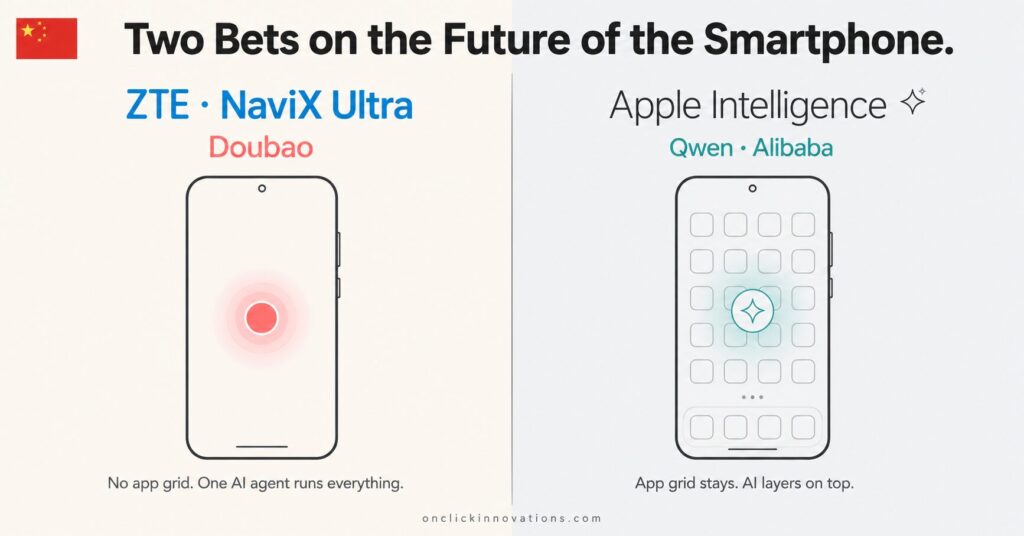
Picture picking up a new phone and not finding a home screen full of app icons. Instead, there’s one button. You press it, say what you want, and the phone figures out which apps to open, in what order, to actually get it done.
That’s not a concept video. It shipped. At the World Artificial Intelligence Conference (WAIC) in Shanghai in mid-July 2026, Chinese telecom giant ZTE unveiled the NaviX Ultra under its Nubia brand — a smartphone it calls the world’s first agentic AI phone. Days later, Apple finally received approval to bring its own AI assistant to mainland China. Two very different bets on the same question just landed in the same market, in the same week.
What “Agentic” Actually Means Here
The word “AI phone” has been used loosely for years — usually meaning a phone with a chatbot app, a photo-editing feature, or a smarter voice assistant bolted onto an otherwise ordinary interface. Agentic is a specific, narrower claim: the AI doesn’t just respond to you, it acts on your behalf across multiple apps and steps, without you supervising each one.
The NaviX Ultra makes that claim literally. According to reporting from Bloomberg and device previews, the phone has no traditional home screen or app grid in the conventional sense. Instead, a dedicated orange side button (or a voice command) summons ByteDance’s AI assistant Doubao directly. From there, Doubao is designed to map a request — “plan me a weekend trip” or “edit this photo and send it to my group chat” — into a sequence of actions and carry them out across apps itself, rather than making you open each app individually.
Demoed capabilities reportedly included real-time photo editing, generating maps, and building full travel itineraries, all triggered from a single request to the assistant.
The Players Racing for the Same Idea
ZTE isn’t alone, and the pattern across all three shows this is a genuine industry bet, not one company’s marketing stunt.
- ZTE / Nubia — NaviX Ultra. Priced from roughly 3,499 yuan (about $516) and built around ByteDance’s Doubao. An earlier, more limited device from the same partnership, the Nubia M153, reportedly sold out an initial batch of 30,000 units on launch day, with resale prices doubling on secondary markets — a real, if small, signal that consumer appetite exists.
- StepFun. Showed a device running its own proprietary operating system with a built-in agent called Amoo, rather than licensing an assistant from a bigger partner.
- Honor. Spun off from Huawei, reportedly preparing AI-agent-focused devices built on models co-developed with Alibaba, expected later in 2026.
Three different companies, three different AI partners (ByteDance, an in-house model, and Alibaba), all converging on the same structural idea: put one agent at the center of the phone instead of an app grid.
Why This Is Happening in China Specifically
This isn’t a coincidence of timing. Global smartphone upgrade cycles have slowed considerably — most new phones look and feel like the ones they replace, which makes it harder to justify a purchase. Chinese manufacturers, several of them state-linked, are betting that a genuinely different interaction model — not just faster hardware — is what makes a new phone feel worth buying again.
China’s AI ecosystem also happens to be unusually well positioned to try this first. ByteDance, Alibaba, and Baidu each have consumer-facing AI assistants with hundreds of millions of existing users, giving hardware makers an assistant with real conversational maturity to build a phone around, rather than starting from scratch.
Apple’s Very Different Answer, Landing the Same Week
The timing makes an interesting contrast. On July 15, 2026, China’s Cyberspace Administration formally approved Apple Intelligence for the mainland market — ending a roughly 22-month wait since Apple first announced the feature in 2024. Apple was the only foreign brand included in that approval batch, alongside domestic names including Huawei, Xiaomi, Samsung, OPPO, vivo, and Nubia itself.
The detail that matters most: the AI actually running Apple Intelligence in China isn’t Apple’s own model. Regulatory and data rules required a domestic partner, so Apple is using Alibaba’s Qwen model to power core generative features — text summarization, email drafting, document editing, and image generation — with Baidu also confirmed to be involved in some capacity. Both companies’ spokespeople have confirmed the arrangement; as of this approval, Apple itself hadn’t issued detailed public comment on the setup.
Structurally, this is a different bet than the ZTE approach. Apple Intelligence lives alongside the existing iOS app grid and interface — enhancing it, not replacing it. Samsung’s Galaxy AI takes a similarly additive approach globally. The Chinese agentic-first phones are proposing something more radical: remove the grid entirely and make the agent the interface.
The Part the Demos Don’t Show You
It’s worth being honest about what’s still unproven here. Nubia’s executives demoed the NaviX Ultra’s capabilities on stage but reportedly didn’t disclose chipset details, RAM, on-device model size, or how much of Doubao’s processing happens locally versus in the cloud — details that matter enormously for real-world speed, privacy, and reliability.
There’s also a track record worth remembering. Agent-first phone concepts have surfaced in Western markets before with confident demos that struggled once they had to interact with real third-party services — booking systems, payment flows, and apps that weren’t designed to be operated by another piece of software. A stage demo executing a pre-planned scenario is a meaningfully different test than a live agent handling an unpredictable request against a banking app or an airline’s booking flow. Whether Doubao holds up under that kind of real-world variability is the actual question, and it hasn’t been publicly answered yet.
Instead of juggling multiple apps, these phones are betting that AI can handle the juggling for you. Whether that holds up outside a product demo is the real test.
What This Signals for Software and Product Teams
Regardless of how the NaviX Ultra specifically performs, the direction here is worth watching closely if you build software:
- App design may need an “agent mode.” If phones increasingly let an AI operate apps on a user’s behalf, apps that are hard for an AI agent to navigate reliably could become a real competitive disadvantage, the same way non-mobile-friendly websites became one after smartphones took over.
- Voice and API-first interfaces are gaining ground. An interface built primarily for a human finger tapping a touchscreen isn’t automatically usable by an AI agent acting programmatically. Products with clean APIs and predictable, well-structured flows are naturally easier for an agent to operate correctly.
- Multiple simultaneous bets are healthy at this stage. Apple’s additive approach and ZTE’s agent-first approach are both reasonable responses to genuine uncertainty about what users actually want. It’s far too early to declare a winner.
Where This Leaves Things
What happened in Shanghai this month isn’t proof that the app grid is dead. It’s proof that a serious, well-resourced part of the industry is willing to bet real hardware, real launches, and real money that it might be, while Apple is running the more cautious experiment of layering AI on top of what already works.
Both bets are being tested in the same market, in the same year, which makes 2026 a genuinely useful natural experiment in how people actually want to interact with their phones — not just how a product team assumes they will.
Frequently Asked Questions
What is an agentic AI smartphone?
A phone built around an AI assistant that can carry out multi-step tasks across different apps on a user’s behalf — understanding a request and executing a sequence of actions — rather than simply adding AI-powered features to a conventional app-based interface.
What is the ZTE NaviX Ultra?
A smartphone launched by ZTE under its Nubia brand at the World Artificial Intelligence Conference in Shanghai in July 2026, marketed as the world’s first agentic AI smartphone. It centers on ByteDance’s Doubao AI assistant, activated via a dedicated side button or voice command, and starts at roughly 3,499 yuan (about $516).
Which companies are building agentic AI phones in China?
ZTE (Nubia brand, with ByteDance’s Doubao), StepFun (its own OS with an assistant called Amoo), and Honor (reportedly preparing AI-focused devices with Alibaba, expected later in 2026).
Is Apple Intelligence now available in China?
China’s Cyberspace Administration approved Apple Intelligence for the mainland market on July 15, 2026, ending roughly a 22-month wait. The China version uses Alibaba’s Qwen AI model for core generative features, with Baidu also confirmed to be involved, rather than Apple’s own AI model.
How is Apple’s approach different from ZTE’s agentic phones?
Apple Intelligence adds AI features on top of iOS’s existing app-grid interface. ZTE’s NaviX Ultra removes the traditional home screen and app grid, making a single AI agent the primary way of interacting with the phone.



Pingback: China’s agent‑native phones: how post‑app OS bets reshape mobile - Buildloop AI ⚡ Founder Journey