


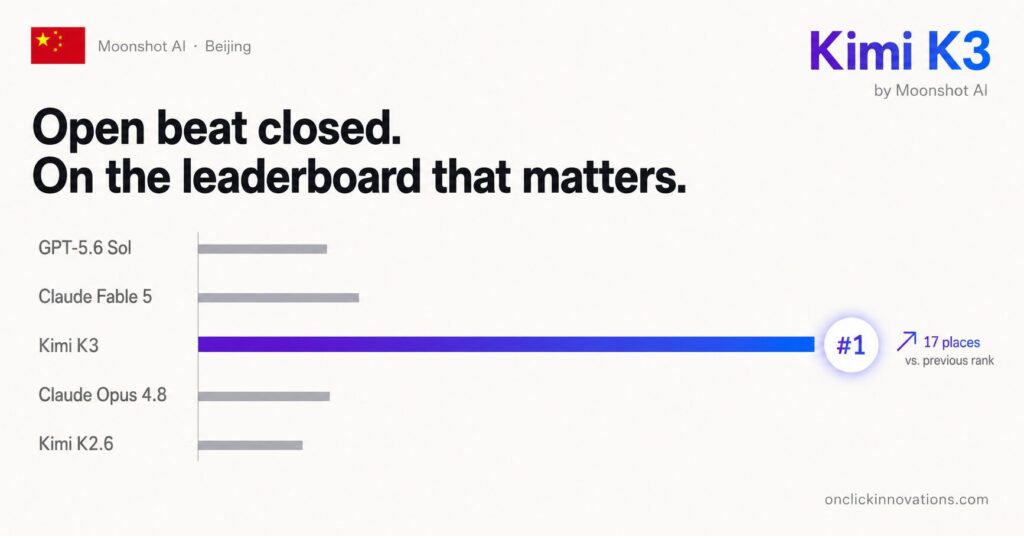
On July 16, 2026, a Chinese AI lab most people outside the industry have never heard of shipped a model that landed at the top of a coding leaderboard judged entirely by real developers voting blind. It beat Anthropic’s Claude Fable 5 on that specific test. And it’s on track to be open-weight within days of release.
Here’s what actually happened, what makes it credible rather than hype, and why the “closed AI has a permanent moat” argument just got harder to make with a straight face.
What Moonshot AI Actually Shipped
Kimi K3 is Moonshot AI’s new flagship model — 2.8 trillion parameters, built as a Mixture-of-Experts (MoE) system. The key detail that makes that number less intimidating than it sounds: only 16 of its 896 “experts” activate for any given token. That architecture is what lets a model with genuinely massive parameter count keep real inference cost far below what a dense model of the same size would demand.
Moonshot is calling it the first “open 3T-class” model, edging past DeepSeek’s 1.6T V4 Pro for that particular title. Alongside the scale, K3 ships with a 1-million-token context window, native vision support, and a new attention mechanism — Kimi Delta Attention (KDA) — that the team reports delivers up to roughly 6x faster decoding at long context lengths. Most models slow down noticeably as context grows; KDA is specifically engineered to fight that.
The headline result: on Arena’s Frontend Code leaderboard — where real developers vote on blind, head-to-head matchups between model outputs — K3 landed at #1. That’s a 17-place jump over its own predecessor, Kimi K2.6, and it placed ahead of Anthropic’s Claude Fable 5 in that specific comparison.
The Part That Makes This Credible, Not Hype
Here’s the detail that separates this from the usual “new model claims to beat everything” launch post: Moonshot’s own materials openly admit that K3 trails both Claude Fable 5 and GPT-5.6 Sol on general intelligence benchmarks.
It is not, by Moonshot’s own account, the smartest model available. What it won was one specific, real-world-relevant contest — front-end code that actual developers preferred, in blind evaluation. That’s a narrower claim than “best AI model,” and a far more believable one.
The moat closed AI labs have isn’t “we’re smarter.” It’s “we’re smarter at everything, all the time.” Kimi K3 just showed that gap can close fast, on the tasks people actually care about.
Framed that way, this isn’t really a “China beats America” story, even though that’s the framing a lot of coverage has reached for. It’s a more precise and more interesting one: an open model caught up on a specific task that matters commercially, while still openly trailing on general capability. That’s exactly the kind of gap that tends to narrow over successive model generations rather than widen — which is the actual reason this is worth paying attention to.
What Makes K3 Technically Different
Two things are doing the real work under the hood, beyond the raw parameter count:
- Kimi Delta Attention (KDA). A hybrid linear attention mechanism built specifically to keep long-context performance from degrading. At a 1-million-token context window, this matters a lot in practice — it’s the difference between a model that’s usable on a large real codebase and one that’s only fast on toy examples.
- Sparse Mixture-of-Experts routing. Activating only 16 of 896 experts per token is what makes a 2.8T-parameter model economically viable to serve at all. This is the same broad architectural family used by other recent frontier models, but Moonshot has pushed the expert count and routing design further than most public releases.
Pricing
K3 is priced at roughly $0.30 per million tokens for cache-hit input, up to $3 per million tokens for cache-miss input, and $15 per million tokens for output. That’s meaningfully cheaper than most closed frontier models — not free, but a real and relevant gap for any team weighing cost against capability.
How to Actually Use It
- Via API. Model ID
kimi-k3, available through Moonshot’s own platform in an OpenAI-compatible API format — low-friction to try if your stack already calls GPT-style endpoints. - Via the Kimi app. Available directly through kimi.com for casual, non-developer use.
- Self-hosting. Not yet available. Full open weights were promised by July 27, 2026; until that lands, access is limited to the hosted API.
- Practical recommendation from early adopters. Several development teams evaluating K3 are treating it as a candidate default-plus-fallback model rather than a wholesale production swap — trialling it against real diffs, tests, and builds before committing meaningful traffic to it.
One more data point worth including for balance: Moonshot briefly paused new K3 subscriptions on July 20, citing GPU capacity limits after unexpectedly high demand. That’s a good signal of genuine interest in the model, and also a fair signal that the infrastructure behind it is still catching up to that demand.
Why This Matters If You’re Building With AI
The practical takeaway isn’t “switch to Kimi K3 today.” It’s a reminder about how quickly the gap between the best closed model and the best available open model can move.
If a product or engineering team has built deeply around a single closed AI provider — hard-coded prompts, tooling, and pricing assumptions with no realistic path to switching — moments like this are a useful prompt to check that exit plan. Not because you should necessarily switch, but because the assumption that closed frontier models will always be meaningfully ahead is getting harder to take for granted with every generation.
Frequently Asked Questions
What is Kimi K3?
Kimi K3 is Moonshot AI’s flagship large language model, released July 16, 2026. It’s a 2.8-trillion-parameter Mixture-of-Experts model, activating 16 of 896 experts per token, with a 1-million-token context window and native vision support.
Is Kimi K3 open-source?
It’s marketed as open-weight, but as of its launch, full model weights had not yet been released. Moonshot AI promised the weight release by July 27, 2026. Until then, access is limited to the hosted API and Kimi’s own apps.
How does Kimi K3 compare to Claude Fable 5 and GPT-5.6 Sol?
Moonshot’s own published materials acknowledge K3 trails both Claude Fable 5 and GPT-5.6 Sol on general intelligence benchmarks. However, K3 ranked #1 on Arena’s crowd-judged Frontend Code leaderboard, ahead of Claude Fable 5 in that specific blind-comparison coding test.
How much does Kimi K3 cost to use?
Roughly $0.30 per million tokens for cache-hit input, up to $3 per million tokens for cache-miss input, and $15 per million tokens for output — notably cheaper than most closed frontier AI models.
How can developers try Kimi K3 right now?
Through Moonshot’s API using the model ID kimi-k3, which follows an OpenAI-compatible format, or through the Kimi consumer app at kimi.com. Self-hosting will only become possible once the open weights are released.