


Published by Onclick Innovations · Engineering Philosophy · June 2026 · 7 min read
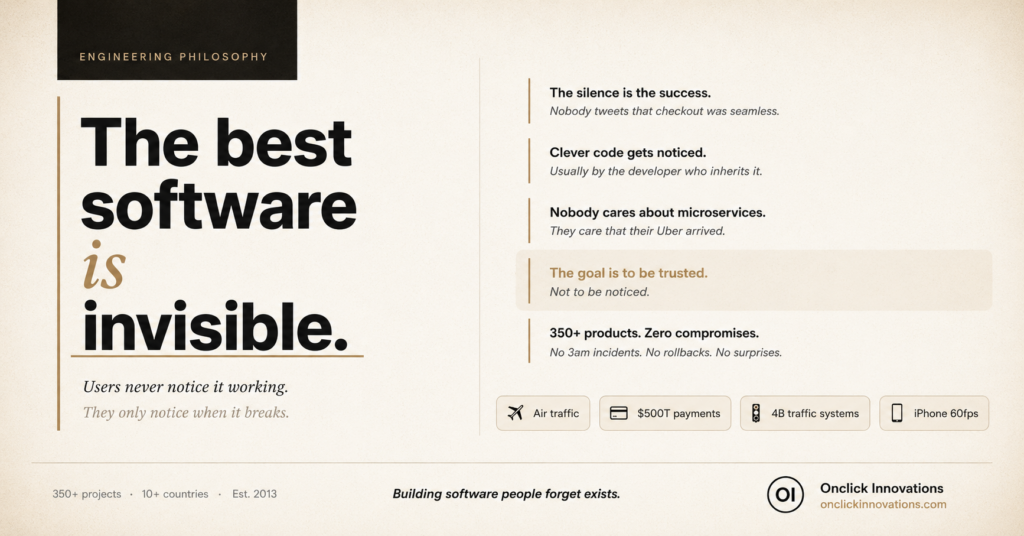
Nobody tweets that checkout was seamless. Nobody calls support to say everything worked perfectly. Nobody posts a five-star review of the payment gateway because it processed their transaction in 180 milliseconds without a single hiccup.
The silence is the success.
This is the central paradox of great software engineering — and it is one that most people outside of engineering never fully grasp. The best software is invisible. Users never notice it working. They only notice when it breaks.
The Invisible Software Running the World Right Now
Before we talk about what invisible software looks like in practice, consider the scale at which it already operates around you.
Air traffic control software coordinates approximately 45,000 flights every single day. When was the last time you thought about the software keeping those planes separated? You haven’t. Because it works. The moment it stops working — a single incident in 2023 grounded thousands of US flights when a safety database file corrupted — it becomes the only thing anyone talks about.
Payment rails process over $500 trillion in transactions every year. The entire global economy moves through software that most people cannot name and have never thought about. When your card is declined because of a processing error, you notice immediately. When it processes in 180 milliseconds as it has ten thousand times before, you do not notice at all.
Traffic light systems operate in cities used by over four billion people daily. The timing algorithms that prevent gridlock and reduce accidents run continuously, invisibly, without acknowledgement. When a traffic light fails and an intersection grinds to a halt, it makes local news. When it works, it is furniture.
The scroll on your iPhone was engineered by a team that spent months ensuring it responds to exactly 60 frames per second — the threshold at which human perception stops distinguishing software from physics. You do not think “this scroll feels good.” You think “this phone feels good.” The engineering disappears into the experience.
This is what invisible software looks like at scale. And it is the standard that every piece of software should aspire to.
What Makes Software Invisible
Invisible software is not the result of clever code. Clever code gets noticed — usually by the developer who inherits it, at 2am, during a production incident they cannot diagnose because the original author was too clever to write comments.
It is not the result of impressive architecture. Nobody using Uber cares about their microservices topology. Nobody using Notion cares about their block-based data model. They care that the product works the way they expect it to work, every time they use it.
It is not beautiful design alone. A stunning interface that takes six seconds to load on a standard mobile connection is not invisible — it is conspicuous. Every user who watches a spinner is noticing your software in the worst possible way.
Invisible software is the result of something less glamorous and more demanding than any of these things:
Obsessive Attention to Edge Cases
The scenarios nobody thought to test are always the ones that surface in production. The user who pastes a 10,000-character string into a name field. The customer who submits a form by pressing Enter twice in rapid succession. The API client that retries a failed request without an idempotency key and creates duplicate records. The database query that performs beautifully on 10,000 rows and catastrophically on 10,000,000.
Invisible software handles these cases gracefully, silently, and without the user ever knowing they triggered an edge condition at all.
Performance Work That Makes Fast Feel Instantaneous
There is a threshold in human perception below which speed stops being a feature and becomes physics. Below about 100 milliseconds, a response feels immediate. Below 60 frames per second in animation, motion feels mechanical rather than natural. Below the threshold of noticeability, software becomes part of the environment.
The performance work that pushes software below these thresholds is some of the most demanding and least celebrated engineering that exists. It requires deep knowledge of how browsers render, how databases execute query plans, how networks introduce latency, and how human perception works. It produces software that people describe as “feeling right” without being able to say why.
Error Handling So Graceful Users Never See Errors
Every system fails. The question is whether the failure is visible to the user or invisible to them. Invisible software anticipates failures and handles them before they surface. A failed API call is retried with exponential backoff. A slow database query returns cached data with a freshness indicator. A third-party service going down triggers a circuit breaker that serves a degraded but functional experience rather than an error page.
Users experiencing invisible error handling do not know anything went wrong. They experience a slightly slower response, or a cached result, or a simplified interface. They do not experience a 500 error, a blank screen, or a lost form submission.
Infrastructure That Scales Before It Needs To
The viral moment, the press mention, the unexpected traffic spike from a social media post — these events do not announce themselves in advance. Invisible software is built for the traffic it does not yet have, so that when the traffic arrives, nobody notices the transition. The load balancers scale. The database read replicas absorb the increase. The CDN serves the static assets from edge locations near each user. The experience remains exactly the same at ten users and ten thousand.
Teams That Celebrate Zero Incidents
Perhaps the most important ingredient in invisible software is cultural rather than technical. Teams that treat a quiet week as a success — that celebrate the absence of incidents rather than only acknowledging heroic responses to them — build differently than teams that treat firefighting as the norm.
The heroic engineer who stays up all night fixing a production crisis is visible and celebrated. The methodical engineer who prevents the crisis from occurring through careful design, thorough testing, and comprehensive monitoring is invisible. Their best work is the absence of a story.
The Paradox of Great Engineering
This creates a genuine paradox for engineering teams and the businesses that employ them. The easiest engineering work to see and celebrate is the work done in response to failure. The hardest work to see and celebrate is the work that prevents failure.
Your best work is the work nobody ever talks about.
Your worst work is the work everybody is talking about.
This paradox shows up in how engineering teams are evaluated, how software projects are estimated, and how technical decisions get made under pressure. The features that users can see and comment on get prioritised. The reliability work that keeps those features working invisibly gets treated as optional, deferrable, something to address in a future sprint that never arrives.
The result is software that is visible in all the wrong ways. The loading spinner. The error message. The lost form submission. The 3am incident that interrupts someone’s weekend. The rollback that takes a feature users depend on offline for four hours.
“The goal of great engineering is not to be noticed. The goal is to be trusted.”
Measuring Success by What Does Not Happen
At Onclick Innovations, we have spent over a decade building software across fintech, healthcare, e-commerce, logistics and enterprise SaaS. 350+ products shipped. Clients across 10+ countries.
The metric we pay most attention to is not the one most clients ask about first. It is not features delivered per sprint, or velocity, or lines of code, or even uptime percentage.
It is this: what did not happen.
No 3am incidents. No rollbacks. No “it worked on staging.” No “we’ll fix it in the next sprint” carrying over for three quarters. No “the database went down because of a query we didn’t optimise.” No “we lost data because we didn’t account for that edge case.”
The absence of these events is the product of the engineering choices made before any code is written. The architecture review that catches the single point of failure before it becomes a production incident. The load test that surfaces the database query that performs fine at 1,000 records and destroys performance at 1,000,000. The error handling design that ensures a third-party service going down does not take the entire application with it.
This work is invisible by design. And that invisibility is the measure of its success.
What This Means for Businesses Building Software
If you are building a software product — whether it is a customer-facing application, an internal tool, or the infrastructure that runs your business — the most important question you can ask your engineering team is not “what are we building next?”
It is “what are we preventing?”
The most powerful thing you can build is software that people forget exists. Not because it is unimportant — but because it works so reliably, so quietly, so consistently, that it becomes part of the environment. It becomes infrastructure. It becomes the thing your business runs on without thinking about it.
That is the goal. Not to be noticed. To be trusted.
The software that achieves this is not built by accident. It is built by teams that have internalised the paradox of great engineering — that the work most worth doing is often the work that, if done correctly, nobody will ever see.
How Onclick Innovations Builds Invisible Software
Every product we build at Onclick Innovations is designed to be invisible in the ways that matter.
We build error handling before we build features. We load test before we go to production. We design for the traffic we do not yet have. We write the monitoring that catches problems before users do. We build the retry logic that handles the failed API call the user never sees. We design the database schema for the query patterns that will matter at scale, not just the patterns that matter today.
We celebrate quiet weeks. We treat an absence of incidents as the measure of a week well spent. We build software that people forget exists — because they are too busy using it to build their business.
📩 Get in touch → www.onclickinnovations.com
📍 Based in Mohali, India · Serving clients globally across 10+ countries
Frequently Asked Questions
What does “invisible software” mean?
Invisible software refers to software that works so reliably and seamlessly that users never consciously notice it. They only become aware of it when it fails. The concept captures the highest standard of software engineering — not impressive features, but flawless, unnoticed reliability.
Why do users only notice software when it breaks?
Human attention is naturally drawn to anomalies and disruptions. When software works as expected, it becomes part of the background — like electricity or running water. When it fails, it immediately becomes foreground. This is why great software engineering focuses as much on preventing failure as on building features.
What are examples of invisible software?
Air traffic control systems coordinating 45,000 daily flights, payment rails processing $500 trillion annually, traffic light timing algorithms operating in cities used by billions, and the 60fps scroll on modern smartphones are all examples of invisible software — engineering so reliable it disappears into the experience.
How does Onclick Innovations build reliable software?
We build error handling before features, load test before production, design for future scale from day one, implement monitoring that catches problems before users encounter them, and measure success by the absence of incidents as much as by the presence of delivered features. Contact us at onclickinnovations.com to discuss your project.
What is the difference between good software and great software?
Good software does what it is supposed to do. Great software does what it is supposed to do so reliably that users stop thinking about it entirely. The difference lies in the engineering decisions that happen before, during and after feature development — the edge case handling, the performance work, the error design, the monitoring, and the cultural commitment to preventing failure rather than just responding to it.