


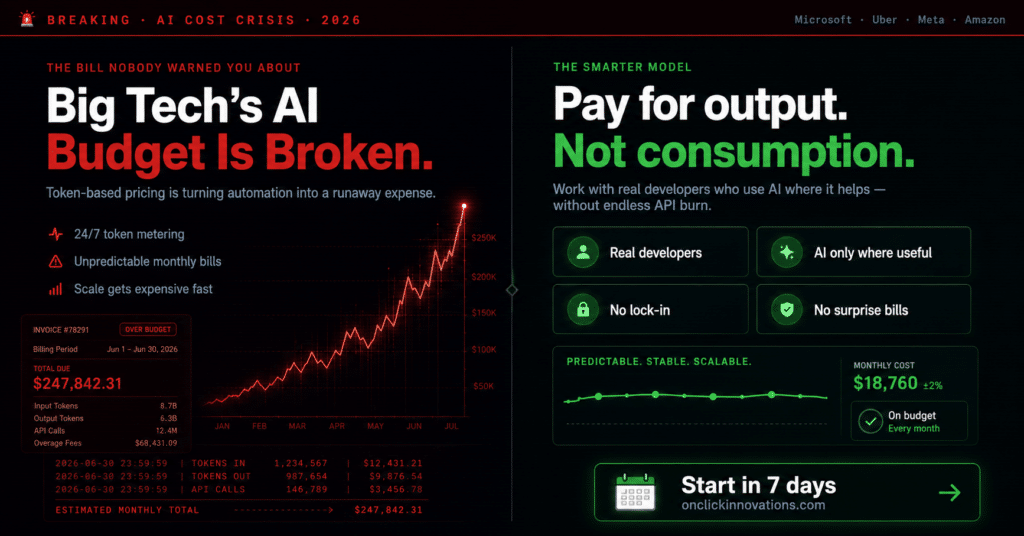
The AI Cost Crisis of 2026: Why Real Developers Are More Cost-Effective Than AI Agents
Published by Onclick Innovations · AI Development · May 2026 · 9 min read
Everyone was sold the dream of AI agents replacing expensive engineering teams. Unlimited productivity. Infinite scale. Dramatically lower costs.
Then Q1 2026 happened. And the bills came due.
This is the story nobody in Big Tech wants to talk about loudly — but it is the most important AI story of 2026. Because it changes everything about how businesses should think about building with AI, budgeting for it, and deciding when a real developer is simply the smarter choice.
The AI Cost Crisis: What Is Actually Happening
The past six months have produced a series of shocking revelations from inside the world’s biggest technology companies. Each one tells the same story: token-based AI billing is creating budget crises that nobody anticipated, even at companies with seemingly unlimited resources.
Here is what has happened, company by company.
Microsoft Cancelled Its Claude Code Licenses
In December 2025, Microsoft rolled out Claude Code — Anthropic’s AI coding assistant — across its Experiences & Devices division. Engineers adopted it immediately. Productivity metrics looked promising. The tool was genuinely useful.
Then the token bills arrived.
By June 2026, Microsoft had cancelled the majority of its internal Claude Code licenses, effective June 30. The directive was simple: developers should switch to GitHub Copilot CLI — a cheaper, less capable tool that Microsoft already owns outright through its investment in GitHub.
The mechanism was a classic enterprise cost trap. Flat seat licenses had kept token spend invisible. The moment Microsoft switched to usage-based pricing, the true cost became immediately visible — and unmanageable.
This was not a performance issue. Claude Code was delivering results. Engineers had come to rely on it daily. The cancellation was purely financial.
Uber Burned Through Its Entire 2026 AI Budget in 4 Months
Uber’s story is perhaps the most striking. After deploying Claude Code to approximately 5,000 engineers, usage grew rapidly. By March 2026, adoption had jumped from 32% to 84% of the engineering organisation.
Individual engineers were spending between $500 and $2,000 per month each — just in API tokens.
Uber’s CTO, Praveen Neppalli Naga, told The Information in April: “The budget I thought I would need is blown away already.”
The company had burned through its entire planned 2026 AI coding budget by April — four months into the year. Around 70% of code committed at Uber now originates with AI, and roughly one in ten live backend updates is shipped by an agent with no human in the loop. The productivity gains are real. The financial model is not.
Meta Built a “Claudeonomics” Dashboard
At Meta, an internal employee built a dashboard called “Claudeonomics” — a nod to Anthropic’s Claude model — specifically to track which employees were using the most AI at work. The numbers it surfaced were extraordinary: 60 trillion tokens consumed in a single 30-day period.
The dashboard was eventually shut down. The consumption it revealed was not.
Amazon Promoted “Tokenmaxxing”
Amazon took a different approach — and perhaps the most telling one. Internal teams began a practice called “tokenmaxxing”: a game where employees competed on internal leaderboards to maximise their AI token consumption. The logic was straightforward: more AI usage meant more productivity.
What actually happened: it accelerated spending instead of controlling it. The leaderboards created a cultural incentive to consume as many tokens as possible, regardless of whether that consumption was generating proportional value.
Nvidia’s VP Said the Quiet Part Loud
Perhaps the most telling statement came from a VP at Nvidia — the company that manufactures the very chips powering these AI systems. In a remarkably candid observation, they noted: “For my team, the cost of compute is far beyond the costs of the employees.”
Read that again. The cost of AI compute exceeded the cost of the human workers the AI was supposed to assist. At Nvidia. The company selling the shovels in the AI gold rush.
The Numbers Nobody Warned You About
These are not edge cases. They are a pattern. And the numbers behind them are significant:
- Per-engineer token cost at Uber: $500 – $2,000 per month
- Enterprise AI agent rollout: $50,000 – $200,000 upfront
- Monthly AI agent running costs: $5,000 – $22,000
- AI software price increases in 2026: 20 – 37%
- Companies that underestimate actual AI costs: approximately 90%
- The four largest tech companies combined AI infrastructure spend in 2026: $725 billion
The uncomfortable reality: AI companies are discovering that, in practice, AI is costing more than the human workers it was supposed to assist.
Why This Is Happening: The Token Billing Problem
To understand the crisis, you need to understand how AI billing actually works.
Think of tokens like a taxi meter that runs on every word generated. Every line of code. Every response. Every iteration. Every retry. The meter never stops.
When AI tools were priced on flat monthly seat licences, this consumption was invisible. Companies saw a fixed monthly bill and assumed they understood their costs. When the industry shifted to usage-based, token-based billing — charging for every line of code generated — the true cost suddenly became visible. And for companies with thousands of engineers using these tools heavily, that visibility was financially devastating.
The shift from flat-rate to usage-based AI billing introduces a new category of expense volatility. Quarterly earnings could swing based on how heavily engineering teams lean on AI assistants in any given period. Finance teams, built around predictable headcount costs, are not equipped to manage this.
The Structural Problem With AI-First Development
Beyond the immediate cost crisis, there is a deeper structural problem with building on AI agents as the primary development solution:
You do not own anything. When you build on a third-party AI agent, you are renting capability at a variable price that the vendor controls. Pricing changes overnight. Terms shift. Availability fluctuates. The companies discovering this in 2026 are scrambling to rebuild strategies around tools they do not own and cannot control.
The meter never stops. A human developer costs a fixed amount per month and produces output. An AI agent costs a variable amount per token, and that cost grows with every interaction, every retry, every refinement. There is no natural ceiling.
You pay for consumption, not results. Token-based billing charges for every word generated, regardless of whether that generation produced value. A developer who spends a day thinking and produces one excellent architectural decision costs the same as a day spent writing boilerplate. An AI agent doing the same charges for every token either way.
Budget volatility is structural, not accidental. As Amazon’s tokenmaxxing experiment showed, organisational incentives around AI usage naturally accelerate consumption. The more you encourage adoption, the more tokens get consumed. This is not a management failure — it is the predictable consequence of metered billing meeting organisational enthusiasm.
The Smarter Approach: Real Developers Who Use AI
The best engineering teams in 2026 are not choosing between AI and developers. They are hiring developers who use AI as a tool — and building systems they actually own and control.
This distinction matters enormously:
A developer who uses AI tools to write code faster is a productivity multiplier. They bring judgment, architectural thinking, context and accountability. The AI is a tool in their hands. The output is owned by you. The cost is fixed and predictable.
An AI agent is a rented service with a running meter. The output may be impressive. The cost is variable, volatile and controlled by someone else.
Why Onclick Innovations Is the Smarter Choice in 2026
At Onclick Innovations, we have been building production software for over a decade. 350+ projects. 10+ countries. Every industry from fintech to healthcare to e-commerce to enterprise SaaS.
Here is what working with us actually means in 2026:
We build with AI and without it — whichever solves your problem. We use AI development tools where they genuinely accelerate delivery. We do not use them where they add cost without proportional value. You pay for output, not token consumption.
You own 100% of everything we build. No vendor lock-in. No API dependency. No scenario where a pricing change or a terms-of-service update breaks your business. What we build is yours.
No surprise invoices. Our pricing model — whether fixed-price project or dedicated team — is predictable. There is no meter running in the background. No monthly API bill on top of your development cost. No budget blowout because your team started using a feature more heavily than expected.
Real accountability. A developer is accountable for outcomes. They can explain architectural decisions, own quality, and be held responsible for the code they produce. An AI agent generates tokens. The accountability gap is significant.
Start in 7 days. No three-month onboarding. No lengthy procurement process. No enterprise sales cycle. We scope your project, agree terms and start building — typically within a week of first contact.
Full-stack expertise across traditional and AI development. Our team works across React, Next.js, Node.js, Python, Laravel, AWS, Docker, PostgreSQL, MongoDB and Redis — as well as AI-specific tooling including GPT-5, Claude, LangChain, MCP, Google ADK and custom agent frameworks. We bring the right tool to every problem.
“Real developers who use AI as a tool — not AI agents that use your budget as fuel.”
The Lesson From 2026’s AI Cost Crisis
Microsoft, Uber, Meta and Amazon are not small companies making naive mistakes. They are among the most sophisticated technology organisations on the planet, with access to the best financial modelling and the most experienced engineering leadership in the world.
They still got caught by the AI billing crisis of 2026.
If it can happen to them, it can happen to any business deploying AI tools at scale without a clear strategy for managing consumption costs and maintaining ownership of the systems being built.
The answer is not to avoid AI. AI genuinely accelerates development when used correctly. The answer is to use it as a tool in the hands of accountable engineers — not as a metered service that runs regardless of the value it produces.
That is the model we have built at Onclick Innovations. And in 2026, it is the model that makes the most financial and strategic sense.
📩 Get in touch → www.onclickinnovations.com
📍 Based in Mohali, India · Serving clients globally across 10+ countries
💬 DM us “HIRE” and we will respond within 24 hours.
Frequently Asked Questions
Why did Microsoft cancel its Claude Code licenses?
Microsoft cancelled its internal Claude Code licenses in June 2026 after token-based billing consumed the team’s entire annual AI budget within months of the pilot launching in December 2025. The decision was financial, not performance-related — Claude Code was working well, but the cost was unsustainable at scale.
How much did Uber spend on AI coding tools?
Individual engineers at Uber were spending between $500 and $2,000 per month in API tokens alone. Across approximately 5,000 engineers, this caused Uber to burn through its entire planned 2026 AI coding budget by April — just four months into the year.
What is tokenmaxxing?
Tokenmaxxing was an internal Amazon practice where teams competed on leaderboards to maximise their AI token consumption, under the assumption that more AI usage meant more productivity. In practice, it accelerated spending without proportional productivity gains.
What is Claudeonomics?
Claudeonomics was an internal Meta dashboard built to track which employees were consuming the most AI. It revealed 60 trillion tokens consumed in a single 30-day period before being shut down.
Is it cheaper to hire developers than use AI agents?
In many cases, yes — particularly when you factor in setup costs, monthly API fees, maintenance and the absence of ownership. A dedicated developer delivers fixed, predictable costs, full IP ownership and genuine accountability. AI agents carry variable token costs, vendor dependency and budget volatility. The right answer depends on your specific use case, which is why we always recommend a scoping conversation before making this decision.
Can Onclick Innovations build AI-powered products?
Yes. We build across the full spectrum — traditional software, AI-integrated products and fully agentic systems. Our approach is to use AI where it genuinely adds value and traditional development where it is more appropriate. Contact us at onclickinnovations.com to discuss your project.