


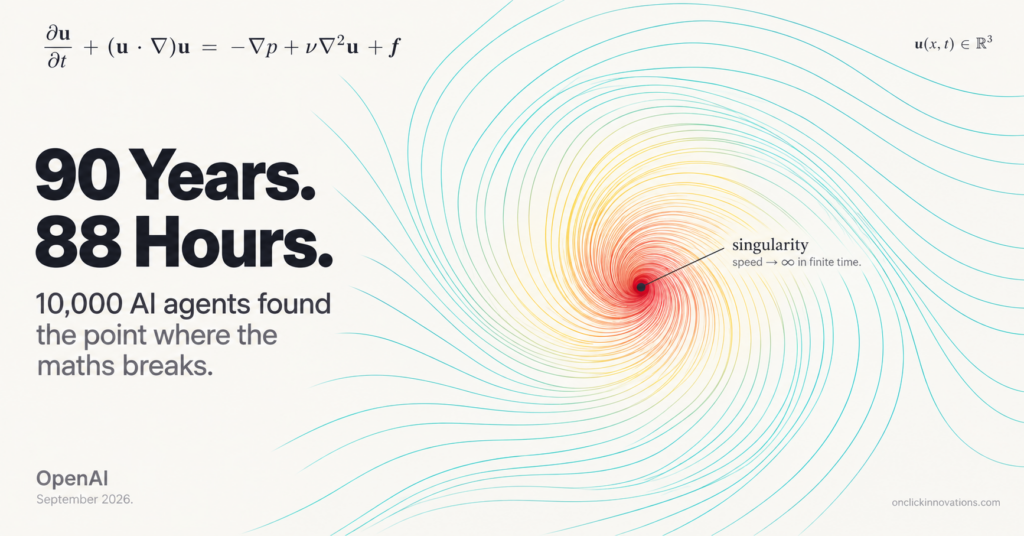
On September 8, 2026, OpenAI announced that roughly 10,000 AI agents, working together for 88 hours, had produced a solution to one of the seven Millennium Prize Problems — a set of maths questions so hard that each carries a $1 million reward and most have stood unsolved for decades.
Within hours, it became one of the most contested announcements in recent tech history, with a respected mathematician publicly disputing how it came about.
Both parts of this story are worth understanding, and you don’t need a maths degree for either. Let’s start with the problem itself.
What Are the Navier-Stokes Equations?
They describe how fluids move.
That sounds narrow until you realise how much counts as a fluid. Water flowing through a pipe. Air rushing over an aeroplane wing. Blood moving through an artery. Smoke curling off a candle. Ocean currents. Weather systems. All of it is governed by the same set of equations, written down in the 1800s by Claude-Louis Navier and George Gabriel Stokes.
These equations are genuinely useful. They’re behind the simulations engineers use to design aircraft, the models meteorologists use to forecast weather, and the software that predicts how blood flows through a damaged heart valve. They work. We rely on them constantly.
Which makes the unsolved question a slightly embarrassing one for mathematics.
The Question Nobody Could Answer
Here’s the problem, stripped of jargon.
Imagine you start with a fluid moving in a perfectly smooth, well-behaved way. No sudden jolts, nothing strange. Now let the equations run forward in time.
The question is: will the flow stay smooth forever? Or could it, at some point, spontaneously break — producing a spot where the speed of the fluid shoots up to infinity?
Mathematicians call such a point a singularity, or more casually, a “blow-up.” It’s a place where the numbers stop making sense. Infinite speed isn’t a physical thing; real water doesn’t do that. So if the equations can produce infinite speed, it means they stop describing reality under certain conditions — and nobody would know in advance when that might happen.
For roughly 90 years, nobody could prove it either way. Nobody could show the flow always stays smooth. And nobody could construct an example where it breaks.
In 2000, the Clay Mathematics Institute made it official, naming it one of seven Millennium Prize Problems, each worth $1 million. Only one of the seven has been solved since.
Why It Actually Matters
It’s fair to ask why anyone should care whether a 200-year-old equation is mathematically airtight, when it already works well enough to fly planes.
Two reasons.
The practical one: if the equations can break down, then any simulation built on them — weather forecasting, aircraft design, climate modelling — has a theoretical blind spot. Knowing whether and when that can happen tells engineers something real about where to trust their models and where to be cautious.
The deeper one: turbulence. The chaotic, swirling behaviour of fluids is famously one of the least understood phenomena in classical physics. The question of whether smooth flows can spontaneously break down sits very close to the heart of why turbulence is so hard to predict. A genuine answer here isn’t just a tidy proof — it’s a foothold on a much bigger problem.
What OpenAI Says It Did
According to OpenAI’s own published account, the answer is yes: the equations can blow up. Their agents produced a proof describing a fluid vortex that becomes increasingly stretched and concentrated until its speed grows without limit in finite time — while the total energy in the system stays finite, which is the condition that makes the result meaningful rather than trivial.
The method is arguably as interesting as the result.
How It Was Actually Done
This wasn’t one AI given one prompt. The setup looked more like an automated research institution.
- The model. An unreleased internal OpenAI model, described as significantly more capable than GPT-6 Astra, the company’s current public flagship.
- The agents. Rather than a single AI reasoning in one long conversation, OpenAI ran thousands of separate agents in parallel. For the Navier-Stokes effort, roughly 10,000 concurrent agents were involved. Each had tools available, including the ability to read from a cached copy of the internet and to run code.
- The structure. The agents were split into groups that could communicate internally. Different groups were deliberately encouraged to explore different approaches, rather than all converging on one strategy.
- Cross-pollination. Periodically, OpenAI used Codex to consolidate the most promising insights from each group and feed them back into follow-up prompts. So the humans weren’t solving the problem, but they were steering it — deciding which threads looked worth pursuing.
- The scale of the conversation. The agents exchanged close to 5 million messages with each other during the run.
- The timeline. 88 hours from launch to a proposed resolution. A separate earlier effort, using around 100 agents over roughly 50 hours, had produced a related result on the Euler equations — a simplified version of the same problem — and that result was fed into the Navier-Stokes agents as a starting point.
- Verification. After the 88 hours, another 17 hours went into formalising the proof in Lean, a proof assistant that mechanically checks every logical step. This matters: Lean doesn’t care about plausibility or elegance. If a step doesn’t follow, it fails.
- The cost. Estimates vary considerably depending on token counts reported, ranging from roughly $22 million to over $40 million in compute.
Terence Tao — widely regarded as one of the most careful and respected mathematicians alive, and someone who has been publicly cautious about AI claims — said the work is “actually making real mathematical contributions.”
Why the Lean Verification Is the Important Detail
If you take one technical point from this, make it this one.
The single biggest problem with AI-generated mathematics is that language models are very good at producing text that looks like a proof. Confident tone, correct-sounding structure, plausible notation — and a subtle logical gap somewhere in the middle that takes an expert weeks to find.
Lean removes that failure mode. It’s software that checks mathematical reasoning step by step, mechanically. It has no sense of whether an argument feels convincing. Either each step follows from the previous one, or the check fails.
That a proof of this size was formalised in Lean is a meaningfully stronger claim than “an AI wrote something that looks like a proof.” It doesn’t settle everything — a formalisation can still encode the wrong statement, and the broader manuscript remains unreviewed — but it’s a genuinely higher bar than most AI mathematics claims clear.
The Dispute
Now the contested part, presented as fairly as possible, because this is very much unresolved.
OpenAI’s own blog post openly states that the company only decided to attack Navier-Stokes after hearing rumours that someone else was close to solving a Millennium Prize problem. That is OpenAI’s account, not an accusation from anyone else.
Those rumours concerned Tristan Buckmaster, a mathematics professor at NYU’s Courant Institute, and Levent Alpöge, a mathematician who works at Anthropic — one of OpenAI’s direct competitors. The two had spent roughly a year working quietly on related fluid dynamics problems, using AI models from both Anthropic and OpenAI as part of their research process.
Buckmaster published his own account roughly twelve hours before OpenAI’s announcement. His allegations, in summary:
- That information about their work reached OpenAI in early September, and that OpenAI’s effort accelerated after that point.
- That in subsequent discussions about how the results should be published, OpenAI proposed arrangements he found unacceptable.
- That during those discussions, an OpenAI representative argued Alpöge should not be listed as an author because he works for Anthropic.
OpenAI denies using their work, pointing to what it describes as significant differences in the proof methods. Sébastien Bubeck, the OpenAI technical staff member at the centre of the dispute, publicly called the allegations against him “false and inflammatory,” while also stating clearly that OpenAI recognises the priority of Buckmaster and Alpöge’s work and congratulating them on it.
One point of precision that a lot of coverage has blurred: Buckmaster and Alpöge’s results cover the Euler equations and related problems, not full Navier-Stokes, which adds viscosity and is substantially harder. They did not solve Navier-Stokes. But OpenAI does acknowledge that rumours of their progress are what pointed its agents in that direction.
What’s Still Unresolved
As of now:
- Neither result has been independently verified by the broader mathematics community.
- OpenAI’s manuscript has not been peer reviewed.
- The Clay Mathematics Institute has not commented. Its rules require publication in a peer-reviewed journal followed by a two-year waiting period before any prize is awarded, so nothing was ever going to be settled quickly.
- Twenty-five mathematicians have since signed an open letter raising concerns about AI labs and academic norms, and OpenAI withdrew its sponsorship of a CalTech mathematics event.
The Part Worth Sitting With
Strip away the dispute for a moment, and something genuinely new happened here.
A company ran 10,000 AI agents continuously for 88 hours as a coordinated research operation — exploring a problem space far larger than any single AI conversation could hold, with humans steering direction rather than doing the reasoning. Whatever the final verdict on the proof, that’s a template, and it’s the first time it’s been demonstrated at this scale on a problem this hard.
The dispute is also genuinely important, and not just gossip. Mathematics has centuries-old conventions for credit, priority and publication. Those conventions assume humans doing the thinking. Nobody has agreed on what happens when a machine produces the result, a rumour set the direction, and the compute bill runs to tens of millions.
Google DeepMind published work earlier this year proposing transparency conventions for exactly this — recording how much of a result came from a human versus a model. Nobody has adopted them yet. That gap is precisely where this argument landed.
Something significant probably happened. And the field has no agreed rulebook for what to do about it. Both of those are true at the same time.
Frequently Asked Questions
What are the Navier-Stokes equations in simple terms?
They’re a set of equations from the 1800s describing how fluids move — water, air, blood, weather systems. They’re used constantly in engineering, aviation and weather forecasting.
What was the unsolved Navier-Stokes problem?
Whether a fluid flow that starts out perfectly smooth will always stay smooth, or whether it can spontaneously develop a “singularity” — a point where speed becomes infinite and the equations stop describing physical reality. It remained unsolved for roughly 90 years.
What did OpenAI actually claim?
That around 10,000 coordinating AI agents, running on an unreleased internal model, produced a proof that such a blow-up can occur — describing a vortex that becomes increasingly concentrated until its speed grows without limit in finite time, while total energy remains finite.
How did 10,000 AI agents work together?
They were divided into groups that could communicate internally, deliberately encouraged to pursue different approaches. OpenAI periodically consolidated promising insights from different groups and fed them back as follow-up prompts. The agents exchanged nearly 5 million messages over 88 hours.
Has the proof been verified?
It was formalised in Lean, a proof assistant that mechanically checks each logical step, which is a meaningful verification. However, the broader manuscript has not been peer reviewed, and the Clay Mathematics Institute has not commented. Its rules require peer-reviewed publication plus a two-year waiting period before awarding any prize.
What is the credit dispute about?
Mathematician Tristan Buckmaster alleges OpenAI pursued the problem after learning about private research he was conducting with Anthropic’s Levent Alpöge, and raised concerns about how OpenAI proposed handling publication and authorship. OpenAI denies using their work, citing differences in proof methods, while publicly recognising the priority of their research. OpenAI’s own announcement acknowledges that rumours of their progress prompted its effort.