


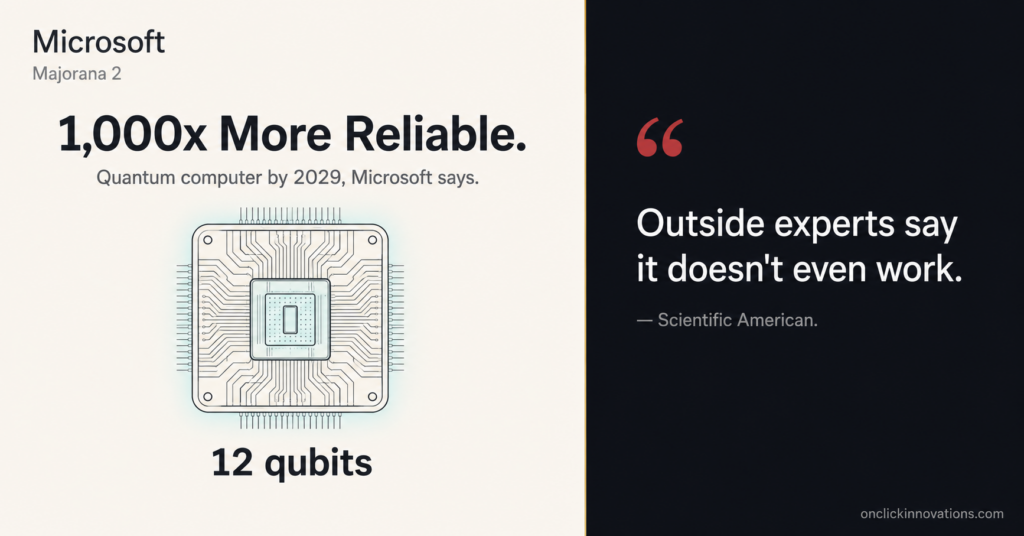
On 2 June 2026, at its Build developer conference, Microsoft unveiled a quantum chip called Majorana 2 and made a claim that got the industry’s attention: qubits roughly 1,000 times more reliable than its previous generation, and a scalable quantum computer by 2029 — four years earlier than the company’s own previous target of 2033.
That’s a big claim. It’s also, as we’ll get to, a contested one. But before any of that matters, it’s worth understanding what quantum computing actually is, because most explanations either drown you in physics or oversimplify it into something misleading.
What Is Quantum Computing, Really?
Your laptop, your phone, and every supercomputer on Earth all work the same fundamental way. They run on bits — tiny switches that are either off (0) or on (1). Everything you’ve ever done on a computer is ultimately billions of those switches flipping.
A quantum computer uses qubits instead, which behave according to the rules of quantum physics rather than everyday physics. Three properties matter:
- Superposition. A qubit doesn’t have to be strictly 0 or 1. It can hold a blend of both at once. (A common analogy is a spinning coin — not heads, not tails, until it lands.)
- Entanglement. Qubits can be linked so that the state of one is tied to another, no matter how they’re separated.
- Interference. Wrong answers can be made to cancel each other out while right answers reinforce — which is what lets a quantum computer actually arrive at a useful result rather than noise.
Put together, this means a set of qubits can explore an enormous number of possibilities simultaneously rather than checking them one at a time. Roughly 300 well-behaved qubits could represent more possible states than there are atoms in the observable universe.
So Is a Quantum Computer Just a Very Fast Computer?
No — and this is where most coverage goes wrong.
A quantum computer is not a faster laptop. It’s a specialist. For nearly everything you do every day — email, video calls, spreadsheets, browsing, even most AI training — classical computers are better, and will remain better. Quantum computers won’t replace them.
But for a narrow class of problems, the difference is staggering. Google’s Willow chip completed a benchmark task in under five minutes that the company estimated would take a leading supercomputer an almost meaningless span of time — on the order of 10 septillion years.
The problems where this specialism genuinely pays off:
- Drug discovery — simulating how molecules actually behave, rather than approximating it
- Materials science — better batteries, catalysts, and new materials
- Chemistry for fertiliser and clean energy — processes that are enormously energy-intensive today
- Optimisation — portfolio management, risk modelling, logistics routing
- Cryptography — the double-edged one, which we’ll come back to
What Makes Microsoft’s Approach Different
Almost every other major player — IBM, Google — builds superconducting qubits. IonQ uses trapped ions. Microsoft took a lonelier path nearly twenty years ago: topological qubits.
The core idea is to store quantum information in a way that’s spread across the material rather than held in one fragile spot, making it naturally more resistant to interference. One way to picture it: a conventional qubit is like a snowflake — beautiful, precise, and destroyed by the slightest disturbance. A topological qubit is meant to be more like a knot tied in a rope. You can twist and shake the rope, and the knot survives.
The headline change in Majorana 2 is a materials swap. Where the previous chip used aluminium as its superconductor, Majorana 2 uses lead. Microsoft’s own quantum lead, Chetan Nayak, acknowledged in the press briefing that lead sounds like an odd choice — but says it meaningfully improves the protective barrier shielding the qubit.
The measured result Microsoft reports: quantum states surviving an average of 20 seconds, with some instances holding for up to a minute — against milliseconds on the previous chip, while individual operations run in about one microsecond. Microsoft’s own comparison is that it’s like replacing a phone battery that dies in a day with one lasting nearly three years.
There’s a second story here too. Microsoft says its agentic AI platform, Discovery, helped design and test the chip — AI accelerating quantum research, which may one day accelerate AI. That feedback loop is arguably more significant than any single chip specification.
The Honest Caveat: This Is Contested
Here’s the part that most enthusiastic coverage skips, and it matters.
Majorana 2 has 12 qubits. Not a thousand, not a million — twelve. (It added four to its predecessor’s eight.) Microsoft’s roadmap to a million qubits on a single palm-sized chip is a design ambition, not a current capability.
More importantly, a significant part of the physics community remains unconvinced that Microsoft has demonstrated a genuine topological qubit at all. Nature covered the announcement under a headline noting researchers are still sceptical. Scientific American was blunter, reporting that outside experts question whether the technology works as claimed. The underlying results were posted as a preprint that has not been peer-reviewed, and the broader field of topological quantum computing has a history of high-profile paper retractions — which is precisely why the bar for convincing physicists is so high. Separately, the journal Science has opened an inquiry into data from a 2020 Microsoft quantum paper.
Microsoft, for its part, points to DARPA scientists embedded in its quantum programme with full access to its data, and says it is performing real computation with these qubits.
This is a bold, genuinely contested scientific bet — not a settled result. Anyone selling you certainty in either direction is selling something.
Where India Actually Stands
India is further along here than most people realise.
The National Quantum Mission (2023–31), run by the Department of Science and Technology, is backed by roughly ₹6,000 crore. It operates through four thematic hubs — at IISc Bengaluru, IIT Madras, IIT Bombay and IIT Delhi — connecting over 150 researchers across dozens of institutions. The stated target is intermediate-scale quantum computers in the range of 50 to 1,000 physical qubits.
Hardware is moving. Bengaluru-based QpiAI launched Indus, described as India’s first full-stack 25-qubit system, in April 2025, followed by a 64-qubit chip called Kaveri, with a roadmap targeting 1,000 qubits by 2030. IISc has built India’s first six-qubit photonic system, generating entangled states using only light.
Quantum communication is moving even faster. India demonstrated a 1,000 km quantum-secure communication link using indigenous technology, ahead of the mission’s own schedule, working toward a 2,000 km target.
States have entered the race too — most visibly Andhra Pradesh’s Quantum Valley initiative in Amaravati, alongside dedicated missions in Karnataka, Telangana and Maharashtra.
The honest gap: cryogenics, precision control electronics, lasers and fabrication supply chains are still largely imported. That’s the genuinely hard part — and probably where the next decade of Indian deep-tech opportunity actually sits. NITI Aayog has estimated quantum could unlock $1–2 trillion in value by 2035.
Why You Should Care Well Before 2029
This is the part with a real, near-term deadline attached.
Today’s encryption — the padlock icon on your banking app, the thing protecting your medical records — rests on mathematical problems that classical computers can’t solve in any useful timeframe. A sufficiently powerful quantum computer changes that assumption.
The threat isn’t hypothetical or purely future-tense. Security agencies have documented a strategy called “harvest now, decrypt later”: adversaries stealing encrypted data today with the intention of decrypting it once quantum computers mature. If the data still matters in ten years, it’s already at risk today.
The good news is that the replacement standards already exist. The US National Institute of Standards and Technology has finalised post-quantum cryptography standards. If your organisation handles data with a long sensitivity horizon — health records, financial data, legal documents, government information — migration planning isn’t a 2030 problem. It’s a 2026 one.
What to Actually Do About It
You almost certainly don’t need to buy a quantum computer. Three things are worth doing now instead:
- Build a cryptographic inventory. Know what encryption your systems use and where. Most organisations genuinely don’t, and you can’t migrate what you haven’t mapped.
- Identify which of your problems are actually quantum-shaped. For most businesses, the honest answer is none — and knowing that saves you from expensive distraction.
- Start building the talent pipeline. The hardware will arrive on someone’s timeline. People who understand it won’t appear automatically.
Quantum computing won’t replace classical computing. It will sit alongside it — much the way GPUs became essential for AI without replacing CPUs for everything else.
There’s a nice historical footnote here for India: the country was present at the birth of quantum theory. S.N. Bose’s 1924 work is why we still say “boson.” The open question is whether India is equally present for the engineering.
Frequently Asked Questions
What is Microsoft’s Majorana 2 chip?
Majorana 2 is Microsoft’s next-generation topological quantum chip, unveiled on 2 June 2026 at Build. It has 12 qubits, uses a lead-based superconductor instead of aluminium, and Microsoft claims a 1,000-fold improvement in qubit reliability, with quantum states lasting an average of 20 seconds.
Is quantum computing faster than normal computing?
Not generally. For everyday computing tasks, classical computers are better and will remain so. Quantum computers are specialists, offering dramatic advantages only for a narrow class of problems such as molecular simulation, certain optimisation problems, and breaking some forms of encryption.
Are Microsoft’s quantum claims accepted by scientists?
Not universally. While Microsoft points to DARPA oversight and reports real computation using its qubits, a significant portion of the physics community remains sceptical about whether genuine topological qubits have been demonstrated. Coverage in Nature and Scientific American reflects this ongoing debate, and the supporting results were posted as a non-peer-reviewed preprint.
What is India’s National Quantum Mission?
A government initiative running from 2023 to 2031 with roughly ₹6,000 crore in funding, operating through four thematic hubs at IISc Bengaluru, IIT Madras, IIT Bombay and IIT Delhi. It targets intermediate-scale quantum computers of 50 to 1,000 physical qubits, alongside work on quantum communication and sensing.
Should businesses worry about quantum breaking encryption?
Yes, but with planning rather than panic. The “harvest now, decrypt later” risk means encrypted data stolen today could be decrypted once quantum computers mature. NIST has already finalised post-quantum cryptography standards, so organisations handling data with long-term sensitivity should begin migration planning now rather than waiting.